(EXCERPT FROM FRESCO-WRITTEN NARRATIVES)
1.
If you remember, in the book dedicated to Pride, we started with the subject who is frustrated by self-expression. He cannot bear himself because psychopathological problems prevent him from realizing his possibility-to-be. We then did not specify whether the subject was aware of the “goal” as a concept. Awareness of the body as the center of action encourages the subject to think about the goals to which it (the body) as a dynamic biological structure should strive. But this incentive is part of the awareness of the possibility-to-be. It does not exist by itself, nor does it affect itself. Body awareness offers powerful insights, excites self-awareness, and contributes greatly. They are a significant additional stimulus. As we see now and could not have known then because of the logic and order of narration, the subject knew that there was some purpose disguised as a possibility-to-be. Since pathological problems are the top priority, the solution of which depends on the future of practical self-manifestations, and thus the achievement of goals and the satisfaction of the possibility-to-be, the subject focused on them. This meant that for him every social obligation was an unbearable burden to bear, every collective meeting and communication that required him to hold and express himself formally – was a nightmare. In other words, most of life’s circumstances were an insurmountable obstacle for him. Therefore, the subject could not concern himself with anything but this prevailing aspect of life, which diluted the objective and famously generalized it. The subject had not built up an instrumentation within himself. That’s why he couldn’t do intimate tasks. He knew neither the self-manifestation, nor the procedural potential of the soul, nor the systematic patterns of action. Summa sumarum, problems and disturbed self-expression gave rise to the subject’s need to rise above himself. By doing so, they illuminated the possibility-of-being-something truly great or greater than oneself. After that, the body and all other properties began to fit into the “big picture” in a complementary way. The challenge-matching face-liked image hindered the subject from one perspective, but helped him from another. Exasperated, the subject wants even more fervently to correct self-manifestation, he is thirsty, he wants to invent new useful predispositions that will pave the way to victory. The innate drive to be better than he is is not loosely embedded in his genes.
Unfortunately, we will not immediately review the further state of affairs. A special action of the imagination, called pure action, constantly runs through the texts in the previous chapter. Pure action constitutes pure imagination. Sometimes such action is obvious, sometimes not. Other times, the same action leaves conflicting impressions. This impression constitutes the core of the twelve basic modes of imagination.1 Wherever we turn in search of the cognitive peculiarities of imagination we will have the same experience. If we look for the cognitive peculiarities of imagination in the hermeneutically perceived external phenomenon-with-appearance we will see how the concrete and what we imagine cross into each other and merge into each other beyond recognition. This is especially true for pure imagination, which bases its pure content on intuitive experiences. There is always a certain duality that intersects within itself and forms an impersonal noematic whole. Duality is divided into sets that belong to one side or the other. While imagining we suffer a kind of dualitatis incommoda stare.2 We concatenate the imaginary x-entities that are x in number. They freeze the reflection, they do not allow it to have a complete insight, although it manages to take a peek and acquires some data about the imagined whole. We face the same experience and the same blessed discomfort, not if we perceive objects subjectively-hermeneutically but if we try to create a certain representation in the mind that will include the intellectual and introspective aspects of the meaning that we assume is intrinsic to the representation. In other words, both the Humian perspective and the Corbinian perspective on imagination contain the intuitive mechanics inherent in imagination.
In all the perspectives of thought, behavior and action described so far, imagination played a secondary and rather limited role. In the above paragraph, if we think more deeply, the imagination is even enslaved to its own intrinsic mode of perception. Imagination is a more advanced version of intuition because it is more illustrative than it. Intuition is more associated with the pure psychomental processes in which the duality that is divided into a multitude within the representation enters. This illustrative departure of imagination from intuition does not save it from the position of modus operandi inherent in intuition. Intuition is this strong feeling. Imagination differentiates intuition in itself by highlighting the pictorial aspects of the pure representation which intuitively manifests itself as a pure psychomental affect. Imagination emphasizes the pictorial, but at the same time it indicates that the intellectual is different-of-the-same, which means it has the same value and is disposed in the same way within the intuitively given representation. The mind further differentiates the intellectual imaginative sides of intuition. In this way, intuition, imagination and mind build on each other metonymically, fit into each other and help the subject to get to know the meaning of the event comprehensively even before describing it concretely.
But there is a process in the history of philosophy that fought to separate the imagination from the homogeneous whole of intuitive representation, and succeeded. Moreover, this unconscious, real and so far undiscovered process helped the imagination to gain freedom, which will further, within its historiographical genesis, delineate the original aspects of its cognitive function.3
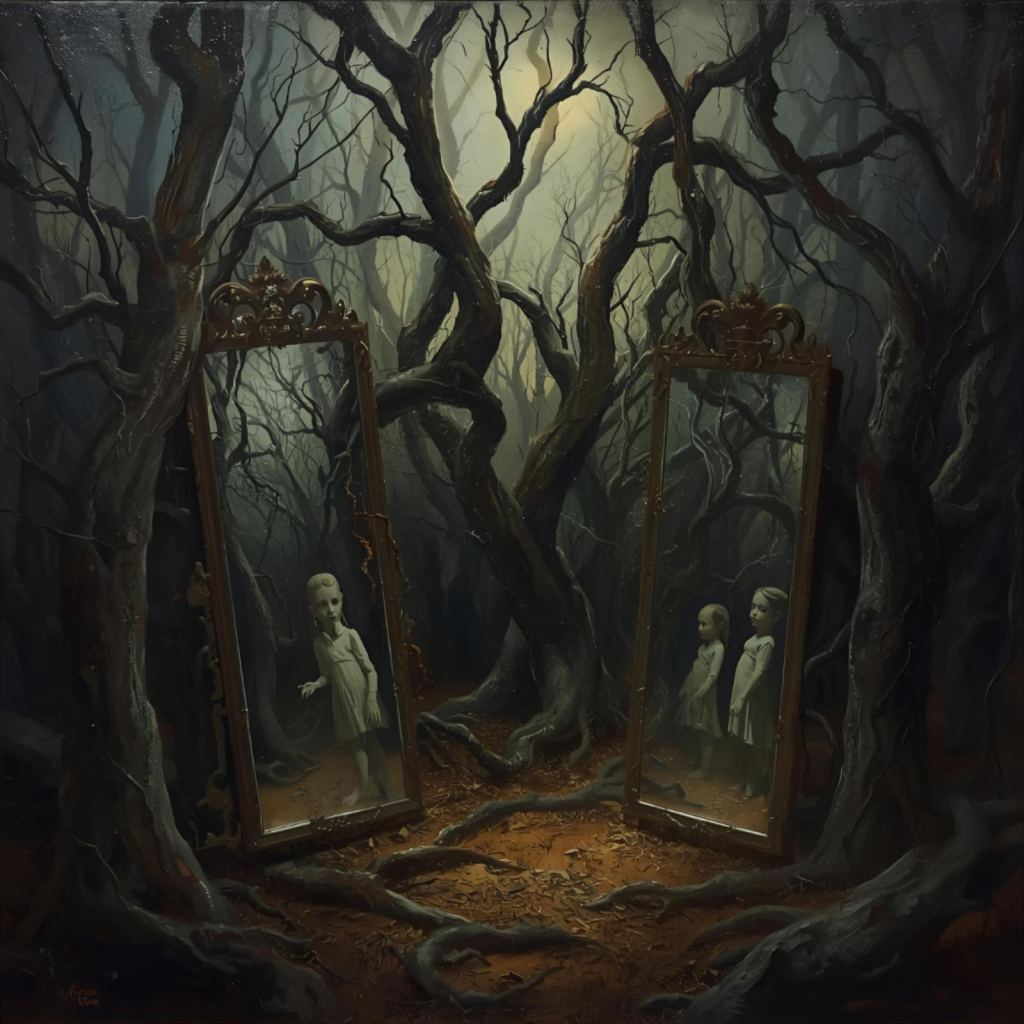
In Native American societies, children were sent into the forest alone to spend the night. It was believed that if they survived the darkness they would become mentally resilient and stop being afraid of the world. In fact, the natives abandoned the children to the wild night, to fight the phantasmagorias of imagination. The night is an externalized expanse of imagination where man projects his greatest fears. But since the night and its darkness embody the core morbid effect of the imagination, it cannot project specific contents, and the night space cannot reflect the contents. The absolute generator of problems creates conditions for problems to manifest absolutely in his “legal space”. Here we are faced with an allegory of the metaphysical representation of the action of the imagination outlined above, where duality paralyzes man as it splits into a multitude of possible representations and perspectives. In the psychomental sphere, man can limit his intuitive representations to a certain number of congruent perspectives. In the coming-of-age ritual, the child faces the absolute multitude projected by the imagination, mirrored in the darkness of night. Thus, the native child is confronted with the core action of the imagination and its more external instrumental space. Such experience, which is acquired under conditions of experimental isolation, has a special meaning for the axial development of imagination. It is not just one of the stereotypical structures of regressus ad uterum, which serves to force man to be reborn, that is, to start living properly by returning to the symbolic womb of the mother4. And parents who lock their children out do so, not to scare them, but to encourage them to change and be better. The world behind the home door, that conditional and temporary wilderness, does not aim to frighten, stress and frustrate the child, but to educate in him firmness and courage, which will cure him of pampering and unconscious whims.5 Parents return children to the mother’s womb, so that they are born renewed and “modified accordingly”.
Such actions shade the imagination and its powerful, independent action. If the child fights with the core affect of the imagination, he will be transformed and start a new life. The therapeutic role of imagination reveals its own immanent power more than the child’s nervous metabolism. Children are left alone with the world around them, where the imagination threatens to unleash the nightmares inherent in unconscious childhood fears. They not only fear the face-like images fused with their concerns that the face-like images will appear as if they were real, but they imagine their fate after the abominations appear for real. Especially the latter, respectively their imagined destiny, unconsciously involves the thinking apparatus. Children do not think soberly about what the false instinct tells them will happen, but the uncertainty forces them to establish basic communication with hermeneutic aspirations. Therefore, the mind instinctively comes into play, without the children being aware of it. In the whole situation, intuition is in advance present and therefore, universal modus operandi. Children do not have time consciously and making an effort to call intuition, so that it can then spontaneously develop into imagination. Suddenly the imagined entities arise, and the speed with which they arise shows that the intuition was acute; it had to happen either concurrently with the birth of the imagined entities, or precedes them, overtakes them with the speed of light, in order to create them.
And the native children left alone in the night, and the children waiting for mercy, at their parents’ door, overcome their fears, because the impulse which made them afraid is extinguished; it cannot compete with the darkness of the night that lasts and the ferocious duration forces it to retreat, leaving the children no choice but to come to terms with the given situation. Thus, the objective duration disfigures the imagination and destroys the actio virtutis univocum redditur6.
This was the first stage of freeing the imagination from the vicious circle of intuition. In such situations, pictorial perspectives always come first. The child faces the surrounding existence and therefore imagines objects compatible with the environment; it imagines corporeal beings whose appearance, character, and behavior correspond to the morbid atmosphere. The next case that we will present will show how humanity, that is, the most perceptive subjects in it, get to know the intellectual tendencies of the imagination in addition to the pictorial. We said that every representation has two sides: pictorial and intellectual. The representation, regardless of whether it is pure, mixed or filled with specific and coherent perspectives, is distributed according to the duality. Duality is reflected in every visible relationship of the entities in the representation and in each entity separately. Thus, not only does the representation contain a homogeneous multitude, but the homogeneous multitude has taken on the nature of duality. The multitude can develop, explain and connect with contents and potentials that may not always, but most of the time, are intrinsic to it. This very awareness of things in the intuitive space has its root in the mind, not in the imagination. But since each meaning is associated with a certain relationship or ratio of static and dynamic pictorial contents, imagination includes mental potentials. We imagine such a complex of relationships pictorially, but the way the complex works is considered mentally.
2.
It is one thing when by imagination we mean the fusion of the image-intellect duality in the intuitive representation and its immanent equality with the multitude. Another is when, imagination meets mind to express its functional freedom from both intuition and mind. By showing how and why the imagination can accommodate both the image and the intellect, it does not emphasize its metonymic dependence on the whole. The flexible shift from pure transcendence (intuition) to pure intellect (mind) and back again indicates how independent the imagination can be if one chooses to focus exclusively on its modus operandi. In our era, it is clear as day why imaginal differs from imaginary. The homologous term imaginal is qualitative, imbued with its own substance as much as the face-liked image. But the face-liked image represents a class of strongly visualized self-projections associated with a particular self-formation; with a certain vision that man cherishes for himself and hopes to achieve. The Imaginal, in turn, represents the core of intuitive representation where duality and multiplicity merge beyond recognition. Imaginal is as substantial as the faced-like image, but what is contained in the dense substance are not the aesthetic-material expressions that leave hylomorphic impressions. In texture and degree of density, the imaginal is substantially the same as the intuition. Both rely on pure transcendental movements and experiences. In the experiences produced by intuition sinks the impression of duality in multiplicity and multiplicity in duality. For the most part, the subject does not transcend concrete contents when experiencing and representing intuitively, but transcends the mental sphere as such.
Let’s not forget the role of the mind in all of this. The mind cooperates with the imagination6 before the subject begins to be interested in the deep meanings of life’s occasions. He not only strictly and accurately distinguishes multiplicity from duality; tries to transform them into semantic structures regardless of whether a) they will abstract the existential until it turns into a concept, or b) the existential will appeal to abstract potentialities in order to distort the nature of the concept and subjugate the concept to its own needs. The mind enables and makes another deep, significant and necessary division. He saves the imagination from its own barrenness. Such a fruitless imagination is the imaginary imagination. The subject imagines imaginarily when he randomly creates arbitrary and non-arbitrary images, scenes and self-projections in the head. He can string them one after the other, or make it more “sophisticated” without curing the sterility, so that he imagines more things at once, restrains the imagination by means of limited multitude, and brings it to the limits of its pure form the more things it will include in the relation of mental entities. While imagining imaginarily, the subject also completely neglects duality and multiplicity as constitutive abstract moments. He deals with multitudes, but does not burden himself with their semantic and meta-linguistic possibilities. It considers one side of the duality without committing itself to it, although it is the primary goal of the objective and meaningless mental process. The imaginal subject in turn emphasizes the unity between duality and multiplicity in order to substantialize representations, whether they appear purely intuitively; regardless of whether they have a pre-given context that the subject recognizes immediately; regardless of whether they are pictorial contents that have transcended the need to discover their inner and extended meanings; finally, regardless of the volume of representations that enter the field of interest. The mind points to this necessary and inevitable possibility. He warns the imagination not to turn into a medium of perception that finds and remembers the impressions of reality to enable the subject to imagine them anew and where the unity of duality and multiplicity hardens and disappears. The mind brings the imagination back to the proper path, always reminding it to implement and generate dynamic and static pictorial contents, which will pass through the sieve of duality and multiplicity. The unity of duality and multiplicity is a pattern that breaks up the psychomental contents so that the subject can more easily know their interiority and put it in an auto-semantic relationship.
The first breakthrough from the imaginary to the imaginal was made by the ancient Greeks. They did not create a homologous correlate of the imagination, but revolutionized the self-identical θανηαζια. They transformed the trivial imagination, which is a specific but arbitrary mental mechanism, into a core of relations between intellectual and pictorial contents, between meaning and existence; between concept and living phenomena. Here, we are not trying to determine the essence of imagination, but to show how through axial development imagination becomes an independent cognitive category. Conditionally speaking, we do our best to prove which points in the historical development of humanity are crucial turning points for, symbolically speaking, the homologous transformation of θανηαζια into imaginatio. In fact, now that we have left the domain of the natives and ascended to the radically more sophisticated Greco-Roman culture, we can speak of the axial transformation of the imagination in a narrower symbolic sense. Imagination becomes independent from the mechanism of intuitive representation, so that it approaches the mind and strives to encompass its principles of functioning in its pictorial basis. The more the imagination becomes perspectively independent with and without the help of its functional relations, the more “it will dance over every “beyond” (Nietzsche), turn into an immanent cognitive function, and become resistant to the full process of conception in order to save its exceptional state from the disfiguring collaboration. It will no longer be pluma fixa in praeter7 raw materials, it will encapsulate all aspects of the process but not be reduced to any. Since this specific segment of the axial sequence of independence refers to Greco-Roman culture, it is called the semantic transition from θανηαζια in imaginatio.
The unitary mechanism of spiritual8 representation takes place in the axis of intuition, imagination and mind. This subjective axis has its cosmological correlate in Plotinus’ Neoplatonism: it is the spiral relationship between the One, the Mind, and the Soul. Plotinus hypothesizes these cosmological-metaphysical categories, attributes to them the most significant characters from ancient mythology. One is Uranus, Mind is Kronos, Soul is Zeus. Uranus forces Kronos to submit to him and cooperate with him in his kingdom. Kronos resists, castrates Uranus, becomes independent, eats his children, except for Zeus who manages to save himself from “family cannibalism”. Symbolically speaking, Kronos is the mind that breaks away from the impersonal realm of ideas, from the Totality of the One, to materialize and conceive them. Kronos castrating Uranus means that Totality without mind cannot contemplate its own realm, just as intuition without vivid representations, and imagination without semantic potentials, are dead functions. However, the mind alone does not have the power to materialize ideas, even when it succeeds in conceiving them immediately. Therefore, the mind wastes its potentials in vain, without any visible result. Obviously, that’s where the idea of Kronos eating his children comes in. Zeus imprisons Kronos in Tartarus, the lowest and most horrible floor of Hell. Zeus, this logically shows us the consequence of hypostasis, represents the Soul. In order for ideas to come to life, an entity must appear on the stage that will give them life and be able to ensure they will materialize.9 But ideas will not be able to remain illuminated and come to life, if the Mind does not play any role in the creation of the world. Therefore, Zeus does not destroy Kronos, but captures him.
In this cosmological analogy of the “creationist” processes, a social archetype is hidden, which will become completely clear to us if we look at the cosmological-metaphysical-creationist10 model of relations from today’s perspective. There are parents who want their children to continue their lives, to play their role after they are gone. They believe that this way the children will save their heritage built carefully, with great love and in the spirit of powerful latent self-love. It is not about irrational parental ambition, but about an irresistible subjective romanticism from which such parents simply cannot release. But they are doing their children a disservice, because often, children also consumed by irrational defiance, do the opposite of what their parents subtly instruct them to do. At the same time, however paradoxical it may sound, they defy their parents by idealizing them and adopting their habits, even transforming their aspirations and moving towards them in the manner of their parents. Children go one step ahead of Kronos and they imitate Zeus. If they are intellectually minded, they create worldviews, overcome the failure of the Mind, and justify the high purpose of the Soul. These two representations, modern and ancient similarly as in the previous axial model, show how within the subjective triad of intuition – imagination – mind, imagination tends to stand out and egoistically leave behind its “immanent companions”. The mind that has separated itself from the Whole, from the primordial “eternal companion” has established unavoidable pattern of archetypal behavior. Because, in the Greco-Roman culture at the time of Plotinus, the term θανηαζια acquired a full-blooded meaning and realized the ideals of the semantic revolution, imagination and mind are one and the same. Plotinus believes this literally, as he creates a two-part term called mind-image that symbolizes the deepened function of θανηαζια.11 When θανηαζια is a technique of forming various original memories, representational retentions, modified reminiscences, and fictional objects and scenes of interest, it is imaginary. When, on the other hand, it embraces the semantic potentials in its vivid arms, it is imaginal. Through the imaginal, Corbin sophisticatedly rebrands mind-images, reshapes them hermeneutically without distorting their narrower essence.12 Technically, it perfectly reimagines the working habits of the “codified” Neoplatonic θανηαζια.
If the Mind frees itself from the Whole, the imagination does the same with it. This conclusion is inevitable, although perhaps the cosmological basis of these metaphysical descriptions does not fit well with our notion of imagination, which is a strictly subjective category. It blatantly shows how strongly the axial transformation of the imagination and its ideological-functional shifts in the complex and multi-perspective system of representation influenced us. In the subjective sense of the word, imagination, following the quintessential pattern of behavior, is freed from intuition just as that Mind has freed itself from the One. Specifically, it represents the substantial dynamism inherent in subterranean mental processes where nothing is distinguished except the whiteness of transcendence and the blackness of all that is partially visible and fully actual in the mental sphere. Ah, that sine necessitate adversus eam argumentationes obviam irent.13 It forced the imagination and the mind to rage, to rebel, to be independent, or at least to think that they were doing so. However, no matter how much they run away, they cannot escape the fact that they belong to an indestructible immanent synthesis, any more than a disappointed child cannot help imitating the parent. The objective ideal is irreversibly introjected into the child.
3.
Fate is ironic. Imagination is not satisfied with independence from intuition. Let no one think that imagination wants to overcome or bypass reason. It, like Zeus symbolically embodied in the cosmic Soul, wants to subjugate reason, to seize semantic potentials, to bind them to pictorial representations and to attribute them to itself. There is no room for two on the throne. Imagination bypassed intuition because it cannot do without it. And Kronos did not dare to destroy Uranus, although he dishonored him and forced him to withdraw from the front stage. What is reason after all without the world of ideas, without the total? A child without a toy store.
This challenge, which imagination will undoubtedly overcome, has an axial pattern. Imagination, understood deeply, almost mathematically controls the phenomena it encompasses with the visual spirit. At the same time, it gives them maximum dialectical freedom, allowing them to seek out each other’s possibilities and to penetrate to the edge of the universe. It is this freedom that Lem speaks of when he describes how he experiences freedom from imposed relationships: “In mathematics I sought what had meant to me in childhood: a multitude of worlds that broke the connection with the imposed so easily, as if they were freed from that force that lives within us, but was hidden enough for me to forget its presence.” Imagination strives to become a principle, not only advocating the freedom of its own phenomena, but a principle that practices the same freedom. The cold breath of transcendentia pura14 hardens the dynamism of intuition. The mind is other-of-the-same. Therefore, it is as flexible as imagination, although the universal language of meanings it represents is corrupted, transformed into a transcendence that plays with geometric forms, turns them into signs and adapts them to the goals it wants to achieve. Imagination does not geometrize scenic representations, and does not turn them into signs. It plays with their consistent and self-condensed beings, changes them, replaces them with each other, moves them on the scale of equiexistence and insistence; it dresses them up, puts them in diverse, experimental relationships. Elements of the changes it causes are recognized in the work of the mind, and it strives to obtain them. We will show how imagination creates the functional constitution by relying on mental constructs after exhausting the possibilities and perspectives of axial development. In this paragraph, we have separated the apparent field of the mind from the apparent field of imagination and formally distinguished them, although a thick line cannot be drawn between them, since every movement and every objective form is based on the physical manifestations of nature.
Imagination tries to steal the function of the mind, to distance itself from its own vivid foundations, so as to preserve the consciousness of them. Imagination considers itself entitled to this, because, as long as geometric forms, written and mathematical signs, energies that can be described by formulas and illustrated linguistically, etc., live and manifest themselves unthinkingly in consciousness, they are “children of its activity”. Thus, imagination claims that the entire mental toolkit and its contents are its own until the mind begins to think of them, or until consciousness begins to tendentiously consider and learn their meanings. Imagination enables consciousness to more quickly imagine what it desires, but as long as consciousness is in a desiderative state, imagination still has the right and power over the property of the mind. Duality and multiplicity are, above all, philosophically abstract entities. On the one hand, they refer to numbers and their formations, and on the other hand, they represent the (dis)orders of objects in real life. So, imagination sets itself two goals, now that it has felt the power of its independence. It wants to appropriate the ideal apparatus of the mind and wants to keep itself at a relative distance from the pictorial basis so that it can devote itself to the stolen instrumentation. It stands with both feet on two different territories in order to emphasize its power over both. The first in history to conceive this dual aspiration of imagination, to systematize it, to schematize it, and to arrange the schemas inversely in order to fit them into each other was Saint Clement of Alexandria.15
Saint Clement of Alexandria gives credit to imagination in advance and treats it as an imaginal function. And more than that: for him, imagination is not just a profound cognitive apparatus, but an apparatus that realizes itself in the world of religious symbolism. For him, there is no imagination that is reduced to a super-functional cosmological miracle. It is astonishing that the world of religious symbolism, for him and in that ancient time seen from today’s perspective, originates in the subjective sphere and returns to it completely enriched by the universal collection of symbolic illustrations. Imagination as an imaginal function completes the work and thus confirms the inescapable value of the imaginal form. This starting position, cosmopolitan in the most sublime sense of the word, is miraculous in itself. But it is most significant because without it, imagination would never have continued to advance axially. Saint Clement of Alexandria rejected the shameful stamp of an imaginary function and its to some extent technically useful triviality. More importantly, he showed the profound function of imagination from the prism of the imagery of picturesque contents.16 He did not gather all the visual-hermeneutic symbols just to show how profound imagination can be, but presented them from the point of view of the accepted meaning that the scenic display or the painting essentially turns into images.
The first part of Saint Clement’s scheme17 (if we can call his comprehensive rational procedure that) consists of three steps. A person must know the object of interest well (here the idea of the primordial participation in the life of the face-like images, regardless of their symbolic density, breadth and depth, sneaks in through a small door). He calls the thorough knowledge of a thing γνώσις. Once a person knows the thing, he strives to use it in this or that way. The attempt to use what is thoroughly known, Saint Clement calls ορμή, striving. Only thorough knowledge enables a person to know what is useful for him in the object of interest. Accordingly, striving can also be called an attempt to use what is useful, provided that a person knows the object thoroughly. Thoroughness is a conditio sine qua non that rethinks the simple meanings of these causal concepts. After he has striven for what is useful in the thoroughly known object of interest, he comes to know the useful element, and is inspired to act. The scheme is quasi-behavioristic because St. Clement speaks of acting within the framework of understanding, not outside it. The nature of the science of behavior in him is epistemological. The useful element encourages man not only to strive to perceive what is useful, but to adopt the useful and apply it. Thus, action has a double purpose, just like imagination in this third axial pattern. First, action implies adoption, then actual application. Therefore, St. Clement uses the word πρήσσω, and not ἔργον or πρᾶγμα. Πρήσσω means either to practice something or to bring something to fruition. In his text, adoption is a form of practice, and achievement is a form of application. ἔργον refers to physical activity, while πρᾶγμα represents the act in general. πρᾶγμα is more associated with πρήσσω because it reflects some general and abstract activity, which is related to πρήσσω, because πρήσσω implies a two-part sequence, which is as abstract and general as the unified act of πρᾶγμα which can imply any action. And πρήσσω implies different actions. They can be adopted and applied to use both objects from the field of physical work and objects from the field of understanding and interpretation. ἔργον refers to any eminently physical work. The choice of the word πρήσσω is not accidental. It aims to show how understanding transforms and connects physical action with mental action.
Why is this seemingly scholastic definition of behavioral science important to us? Whoever thinks pejoratively about this will be wrong. Adoption does not precede thorough knowledge. Thorough knowledge encourages the subject to strive to adopt and apply what he has come to know. But, in order to know something, one must first adopt it? No, the thing must first be known. But after a person has gone through all the stages in the correct order, the action, πρήσσω, gives him the power to quickly know the meaning of visual symbols, he will adopt the στροφός λόγων.18 Why this is so will be shown to us by the following, implicit scheme.
Isn’t this how imagination works when confronted with a certain stage display? It appropriates the stage display and thereby seems to show semantic interest in it, although it cannot generate literal meanings on its own. The man who imagines what he wants to know because of its immanent appeal, anticipates the above-mentioned scheme. The imagination and its content strongly press him to anticipate the scheme and its useful essence. This affective move of the imagination steals from the mind its role. Instead of the mind encouraging the man to see and know the scheme because the scheme promotes him, the imagination takes the opportunity and pushes him to begin to realize the circle of perfect understanding and to educate a hermeneutic instinct. The visual dynamics of what is to be known impose themselves on understanding and meanings. This is an objective, spontaneous and inevitable process. Yet, in this case, the hermetically sealed imagination of visual content threatens, as Nietzsche sings, “to love truth as a selfish possession”.19 The “relationship” of imagination to the relates20 in unity is desperate, just like the One and the “romantic” parent.
4.
As we have indicated, the appetites of the imagination grow. It wants to take possession of the instrumental field of the mind. For this purpose, it even temporarily leaves its kingdom. However, we will not be able to explain how this happens if we do not first describe the second scheme of understanding and acting in accordance with what is understood and while the object is being mastered. It fits into the first more general scheme inversely; it supplements and significantly expands the structure of the quasi-behavioralist delving into the contents of knowledge, which Saint Clement calls φρόνησις, i.e. understanding.
In order to know the object of interest directly, without studying its particular aspects, one must practice νόησίς, to think purely about the object independently of its clarified characteristics. But the subject cannot and must not stop there and be satisfied with that. Next, the subject does not yet have to study and know the characteristics of the object, but while thinking purely about it, he must collect evidence for its existence and the importance of the object itself. Here, he alludes to all the objective aspects that are necessary to establish the hermeneutic thematic horizon. But convenient sporadic knowledge of the object is not enough, it must grow and develop. One must begin to study the object itself and its characteristics, until one knows perfectly well its foundations that pave the way for new qualitative knowledge and begins to realize the practical spirit with the help of which one will gain insight into the possibility-of-being. The first type of knowledge, which arises from the knowledge of the subject’s inner horizons, coincides with the first principle of the general scheme, γνῶσις. The second type of knowledge coincides with the whole idea of the adoption and application of the subject of interest, σοφία. If a person is able to encompass all these perspectives, to know them and to study them further within the framework of the known subject, he will acquire true knowledge, called επιστήμη. The correlate of action in the inverted scheme is ευλάβεια, devotion. It is a rational urge that encourages him to realize without question the perspectives that he has come to know while studying the subject of interest. After that, correct thinking replaces pure thinking. Only after a person has introjected into himself and transformed into a perfect instinctive procedure the knowledge of the subject, regardless of whether it will be a maxim to be followed or objective knowledge to be demonstrated, will he be able to say for himself that he has formed a correct opinion about the subject. The word “δόξα ορθή” represents the ideal active unity of knowledge adoption, action and application. With δόξα ορθή the first part of the general scheme of understanding is detailed on a microscopic level. But we must not forget the second part, the “στροφός λόγων”, which is homogeneous and seemingly too simple, but which symbolizes the most difficult part of the sphere of systematic understanding.
The knowledge of the object through action, adoption and application, turns into a complex of techniques that, in one way or another, modify and practice understanding. Such proprietates autem rei perficientur21 reflects experience, that is, τέχνη. Accordingly, τέχνη is not a feeling that a person has reached the essence of the object that lasts as long as he introjects it into himself and after he has appropriated it perfectly well, but a deep awareness of comprehensive knowledge that is based on practical actions. Without this segment of the knowledge of the state of things in the dynamics of understanding thus conceived and understood, a person simply cannot penetrate the secret of στροφός λόγος (visual symbols). With the help of the awareness of this structure of understanding, a person acquires an exceptional privilege: not only does he know the perfectly well-conquered thematic horizon of visual symbols, but he begins to automatically understand in an unusual way the new contents that flow into him. In other words, he experiments instinctively with the new contents. He is able to penetrate their symbolic essence and decipher them by interpreting them in his own way. The previous knowledge of the thematic horizon trains him to experiment with visual symbols on the fly. The subject compares the previous experience with related themes. This is enough to touch the nerve of symbolic transformation. Saint Clement has this type of understanding in mind when he says: “εμπειρία (experiment) is an attempt to build and create something, without previously studying its first causes and by referring only to similarity or analogy”.22 To build something new does not mean to acquire a thematic horizon that is not connected with the perfect knowledge of the subject. Just as the first cause does not mean the immanent nature of elementari phaenomenorum comprehenso,23 but rather that the subject cannot know in advance the prospects of a symbolic transformation of the visual content. By instinctive skill of experimentation we do not mean that a person suddenly structures the intuitive image that comes to him after he is confronted with the basics of symbolic representation. In the intuitive image, the structure of the understood meaning can suddenly and chaotically-organized appear. But most often, a person understands the transformed meaning of the visual symbol without seeing its structure mentally.24
To get a complete picture of the meaning of the term experience as Saint Clement of Alexandria presents it in his work, we will need to determine the origin and historical development of the word experiment as we understand it today. The terms experimentum and εμπειρία are considered under the umbrella of the cumulative word experiment, because they are axial nodes, crucial historical points that allow a gradual turn in the understanding of the cumulative homologous center to occur. They are its retentive replicas. It is the final product that illuminates their progressive differential meanings. We will not determine the picture of development either upwards or downwards. We will start from the middle. The associative potential of the Latin term experimentum will expand in two opposite epistemological-historical directions. It will harmoniously reveal the meaning of the ancient Greek εμπειρία and the meaning of the modern experiment.
The Latin exsperimentum is divided into the cogenitives experior and mentum. Experior denotes two things simultaneously: a) the risk that a certain X takes on himself while trying to do something and b) the experience that the same X acquires while facing the unstable future of the process. On the other hand, mentum implies a certain group of people or objects. After crossing the two cogenitives we get a semantic picture of the modes of cooperation between the meanings that the cogenitives contain as separate words. It is obvious that the cogenitives experior and mentum limit each other when they enter into a cumulative relationship. We need to find out how. From the perspective of mentum, the unknown someone exposes himself to risk while trying to do something in social and empirical conditions. Or the unknown someone has drawn others, the set of people, into his risky activity. Or the others are witnesses, who consciously or unconsciously expect some outcome, knowing that the unknown someone has taken on a difficult task and perhaps wants to show off to them, or at least want to see it. In the first case, the risk weighs more because if others are involved in the attempt, it means that the task is beyond the strength of the individual stranger. In the second case, the other is doing something that is difficult and risky, and because he does it in the presence of several people, we assume that his intentions are exhibitionistic. What remains to be an absolute segment of the process is the formal attempt and the experience that the unknown someone, or group of people, acquires while performing the task.
If this understanding is homeostatic, then how are we to understand the correlates in experimentum in the light of what we have said above?
Risk is the strongest indicator that the unknown someone is trying to perform something that involves structural actions. Whatever the initial position of the unknown someone and however naive the potential situation may seem, what he will initiate with the initial action will have to be overcome while facing many obstacles and challenges. The obstacles and challenges will be connected to the situation and its internal implications. That is why the situation is potential. The risky attempt processualizes the action; it confronts him with unpredictable possibilities that come from outside the developing situation. He may believe the situation to be funny and harmless, so he does not think about its processual tendencies. But regardless of whether the unknown someone works with a group of people organized to regulate the operational elements and objects of the ambitious task, or performs exhibitionistically, taking responsibility for serious and dangerous acts that end in ridicule and the loss of his “career”, he is self-processualizing within the framework of the unknown that he wants to systematically overcome. The unknown, in turn, demands that he pay by trying in order to buy experience. The processual nature of the attempt and of the situation that the attempt encourages and overcomes, creates the conditions for cultivating structural consciousness. The process is a structure based on certain dynamics. The unknown one makes progress within the framework of the structural dynamism, copes with it, cooperates with it, adapts to it and partly builds its flexible trajectories. Thus, he acquires awareness of the processus which is nothing other than progress that is actually achieved. Processus is figuratively implied in the term experimentum, builds on it and illuminates it from its own perspective.
The Roman mind is privileged to gain a special experience from court hearings. These are organized events that allow it to strictly classify the attempt, the experience and the process. The court hearing is a spontaneous process that takes place within the framework of formal procedural norms. The process is woven from formal paths of action and room for maneuver within the framework of the formal procedure, which is flexible and adapts to the dynamics of the court. Obviously, the judicial challenge is at times more complex and difficult than the potent situation. Open uncertainty is no more terrible than the uncertainty that is due to careful “algorithmic” action. It increases the risk and the fear of risk, and thereby overestimates the attempt. This immediate experience encourages the “experimental mind” to address the procedural side of the hearings. It is essential and increases the value of the processus. The procedure is more comfortable than premeditated and unschematized self-processualization, the pattern of which is created as the person faces the challenges that arise before his eyes. Because of this, in addition to reinforcing the affectivity of the basic cognitive meanings, an awareness of the true weight of progressus is added to them.
5.
Now that we have recognized this crucial state of affairs, it will be easier to understand in what sense experiment and εμπειρία are related to experimentum.
As part of the experimentum the unknown one sees himself as part of the immediate process that he is to co-shape and co-constitute. Whether his exhibition, what he is to show as he attempts to perform, will be a collective engineering construction of a catapult, a difficult court case, a circus act, a tactile construction operation, or a slippery oratorical performance. To be risky, the process, its potentials, and the attempt must be characterized as a difficult demonstration. The Roman-experimenter tries to control the process he has set in motion as it unfolds spontaneously by itself. On the one hand, he confronts its spontaneous unpredictability, on the other hand, he does everything he can to structure it against the unfavorable course of formal circumstances. The one who tries there stands out from the process, although he acts at its heart. Εμπειρία reflects a different dynamic between the risky attempt to manage the initiated process and the role of man in it. The subject observes a certain natural process, or realizes the technical one. The empirical dynamics inherent in the entire process are causally known. The experiment is an intrinsic predicate of dynamic structures. Every natural and artificial process has a completed theoretical-practical constitution. Regardless of whether the subject realizes the process, assists it, or only observes it in order to know it, it is an abstract element that “marks” the dynamic structures of the visible phenomenon. Therefore, in εμπειρία, the experience itself is called an experiment. The one who participates in some way in the process, or produces it himself in its entirety, gains experience of it, regardless of the degree of risk. Since the experiment has nothing separate, and is attributed to experience, the exhibitionistic nature contained in the experimentum is also called into question. Man does not have to repeat the process to know that the process can be repeated. It repeats itself continuously throughout human life. The visible dynamics of the empirical structure are experimental because the way in which the process is obvious to experience. The experiment is hidden in the formations of empirical truth. Kant tried to save the foundations of what we call the ancient understanding of experiment and experience by extracting the experimental meaning from εμπειρία, in order to establish the a priori. The a priori objectifies and transforms into an “immortal truth” every part of the process, whether technical or natural, based on the principle of strict cause-and-effect development. He reproduced the echo of what had long been lost and transformed into the pure predetermination of actions within the structure.
During the scientific revolution, the term experiment gained immense importance. It refers to a person who places himself at a certain distance from the process in order to try to achieve what no one has achieved before. This time, experience teaches the subject that the repetition of certain processes gives him knowledge about the same processes. This knowledge helps him to transform previous experiences and to use appropriately the structures of the known processes that are repeated in order to abstract the old process and establish a new one that will give him the necessary results. If it is a matter of abstract novelties based on the operation of the old process, it is a mathematical experiment. If, on the other hand, the abstract knowledge of the old helps a person to develop a new concept for material operation and to test them materially in the empirical field, then it is a matter of mechanical experiments. The attempt may (if it is mechanical), but does not have to contain risk in itself (if it is mathematical). His exhibitionist propositions are relative because the experimenter places himself in different situations that constitute different relations between the one-who-shows-off-trying-to-the-public and its curious gaze. Man has complete control over the process from beginning to end, although he tries, so to speak, to keep a distance with indignation; although the actions do not predict success. He creates the conditions for the process, even when he encounters spontaneous processes from which he must extract abstract empirical regularities. However, the conscious and conditional separation from the other is the most characteristic feature of the one attached to the experiment.
Each semantic direction given by the three homologous concepts assumes paths of uncertain development, regardless of the meaning of the attempt, the degree of risk, the exhibitionistic state, the operational position, the weight of the preferred action and the abstract-physical, that is, mathematical-mechanical complexity of the process. Having become acquainted with all the homologies, it is especially easy to determine why experimentum best illuminates the axial form of experiment and εμπειρία. Experimentum is a golden mean that emphasizes “actual extravagances,” but promotes the attempt to achieve something as processus, as the realization of processes, as the mastery of problematic structural dynamics. Εμπειρία was entirely based on the “a priori continuum of predetermined occurrence”; on the idea that a plausible dynamic structure precedes the attempt to achieve it. The knowledge that something can be repeated in the way it is repeated constitutes experience. The predetermined course of the process, the complex of possible dynamics, and its homomorphic interiority constitute the experimental nature. The subject is irrelevant. The scientific revolution used phenomena that are structurally prone to repetition in order to discover new truths in and about them through their repetition. The subject is delightfully ridiculous: it stands in opposition to the experiment as if it were a living being with whom it argues and argues. In all homologous-axial situations, the qualitative predisposition of the properties of the experimentum, such as risk, attempt and experience, decreases, transforms, grows. In experiment and εμπειρία, risk visibly decreases, attempt is transformed, experience grows thanks to the axial development of homologemes. The subject’s action in the world is upgraded, reshaped and intensified. He changes the nature of the processes by redimensioning the old processes. Thus, he secures a better place for himself in the process regardless of how complex his experimental basis is.
We have performed historiographical feats in order to make a key point as transparent as possible. Scientific revolution extends far into the past. Accordingly, the merit of Saint Clement of Alexandria for the systematic advancement of the universal research field is not small. Two things are related if their similarity is obvious in advance. If, on the other hand, things seem to be related, but we are not completely convinced that this is so, they are similar. Intuition plays with these comparative forms of power. Sometimes it forces a person to see things as similar, sometimes it rejects their similarity. Procedurality includes these assumptions. Without them, it would not reflect strict flexibility. In each procedure, the subject tries to understand how to satisfy procedural norms, while at the same time managing to use its formalistic advantages. The more knowledge of processes develops, the greater the shifts in the sphere of experiment. Visual analogization, by which meaning is extracted from symbols, is a way of penetrating the secret of processes. The revealed secret further reveals how processes change and transform. Thus, experimental logic penetrates to the center of the predetermined dynamic structure. In the first axial homologous εμπειρία, it began with man and his awareness of the obvious nature of processes. In the Roman experimentum, the subject surrendered to processes in order to decompose their negative aspects. The scientific revolutionary, having just discovered how to expose old processes in order to initiate new ones, began to produce technologies like crazy. Saint Clement of Alexandria took the first serious step towards the worldview of the scientific revolution. He proposed a formal technique for discovering new perspectives, i.e. ideal understandings, by comparing two meaningfully convergent structures. The modern scientific-revolutionary perspective deepened the ancient mechanism of meaningful convergence. Instead of comparing two equivalent metalinguistic structures and analyzing them on a self-identical linguistic level, it derived the abstract structure by gaining experience of the material one by transforming the immediate physical relations into configurations of qualities and properties. The latter are completely different from the visible physical phenomena according to the dynamic image. In other words, the interpretation of convergent visual symbols contains comparative descriptions, which, even when they treat metaphysical phenomena, such as the soul, drives, self-consciousness, God, etc., fit into linguistic illustration. Mathematical illustration, on the other hand, does not duplicate linguistically concrete physical situations. It describes the unfolding of physical phenomena, with a language that has nothing in common with existential illustrations. However, the technique of placing two structures opposite each other precedes all comparative models. Saint Clement of Alexandria mechanized the principle of contrasting analogies. Thus, he advanced the possibility-of-trying-out-the-imagined and encouraged comparative invariants.
The merit mentioned in the previous paragraph has shown that not only do the general and inverse schemes overlap, but also why the Byzantine concept of understanding (which we have placed in the general Greco-Roman tradition) would play a special role in future scientific-revolutionary steps. Knowledge of the object, action, adoption, application and deciphering of visual symbolic secrets developed with the help of the inverse scheme, although they contained it within themselves. Each element of the general scheme has two correlates that are part of the inverse scheme. An unbreakable rule, at least in the life of animals and humans, is that the container is more complex than the contained. The microscopic volumes of the contained are ideal for the development of small and detailed structures.25 In such situations when comparing the relatively simple construction of the “cover” and the complex mechanism that it protects, it is difficult to determine the quantum spacium26 that arises as a consequence of the differences between the relatively simple and the mechanically complex. But how will we prove that if we don’t actually overlap the schemes, if we don’t incorporate the inverted scheme into the general one?
Everyone who begins to imagine deeply does so in order to know a subject that will help him rise in life. Regardless of whether he will use the general aspects of understanding to gain intellectual prestige, or apply them to act wisely. The general scheme allowed us to anticipate precisely this initial side of deep imagination, that is, imagination attached to the imaginal form. The acquisition of knowledge, mental action, assimilation and application, which again serve to perfect practical action, self-expression in the world, were divided into practical and objective moments that more deeply illuminate the pale essence of the former and founded their generalized feature. Pure thought helped the subject to get to know the object and its prospects directly. νόησίς supported γνώσις. Comprehensive scientific knowledge about the object, that is επιστήμη, was acquired by collecting external evidence of its essence.27 Thus, he adopted content that should strengthen the knowledge of the subject (επιστήμη), knowledge as such required the support of ορμή (adoption). Having done so, he dedicates himself to what he has learned about the subject, accepts it and applies it without question. He applies what he has learned so reliably that one cannot help but be left with the impression that his work is the result of correct thinking that comes from knowledge of the subject. At this stage, ευλάβεια is united with δόξα ορθή, i.e. dedication permeates correct thinking, in order to idealize action and its consequences. The subject acts from the first moment he begins to deal with the subject of interest. But this aspect of understanding highlights action as a separate category. Correct thinking and dedication belong to ἔργον and constitute its microscopic manifestation, just as the acquisition of knowledge and the addition of knowledge detailed the adoption (ορμή). The repetition of such practices turns into a habit, and habit shows the skill. Skill is the material correlate of correct thinking. Skill is correct thinking carried out in practice. The subject does not exhaust the meaning of the adopted skill. He gains experience that is realized in such a way that he will not transform the techniques of the old skill, reshape their mechanism and reconfigure it to adapt to the new goal. The various objects do not remind him that he should leave the existing practical structure to create a new structure that will emulate the challenges they impose on him. Skill is inexhaustible. He uses the existing practical structure to face problematic structures that will allow him to seek new ways to overcome the challenge without changing himself. Only in this way, experience is contained a priori in the experimental nature of the skill and its techniques, without being reduced at the expense of new approaches. The experimental nature suffers because the practical structure of the skill does not change. The structure cannot evolve together with the objects whose meanings and appearances it seeks to change. This state of affairs, when experience and the attempt to perform something converge poorly towards each other, produces a substantial axial challenge.28 However we may evaluate this axial phase, its underlying concept στροφός λόγων, is based on one-dimensional skill, on τέχνη and on εμπειρία – the attempt to do something that does not agree to transform generic experience.
6.
We had to put the schemes together in order to have a complete picture of how the technical skill of understanding works. Only in this way will we discover what the connection is between the inverted scheme of understanding and the imagination that moves into the realm of the mind in order to feel that it has at least partial control over its possibilities.
The general scheme of understanding influences the psychosomatic composition and encourages the subject to imagine objects of interest that will be significant in themselves; will elevate subjectivity and will have a share in building universal values. He strongly feels the need to learn, adopt, apply and act from all the stated and implicit perspectives. He cannot overlook and bypass the visual existence that is in itself an object of interest or transcends into higher linguistic spheres. This striving of the imagination to rise above its function through the procedures of understanding is called the “embracing of mental potentials”. But imagination goes a step further. It wants to master the mental instrumentation. It is not enough for it to be able to produce mechanical and deep visual contents and images in the soul.29 If we are not mistaken, we have emphasized this several times. Its aspiration nourishes the general scheme because it represents understanding in general outlines. It illuminates a small, but at the same time very significant part of the total picture of states. Imagination exists on the same cognitive level. It anticipates the representative dynamics of the mind, but this only intensifies its curiosity and makes it passionate about seizing the mental sphere. Imagination, or rather the person who is aware of its progressive aspirations, knows that if it gains greater insight into the technique of understanding, it will come to know some of the functions of the mind. Understanding is a consequence of the intentional balance of the mind and the imagination that manages to create the desired semantic configuration. Whichever side begins to work in the hope of advancing understanding tends to overshadow the counterbalance, usurping its functional potentialities. Ideally, imagination and reason overlap in the associative content of the object in order to extract a consistent local truth, but nevertheless remain faithful to the multifaceted orientations, since they have not exhausted the semantic path. To fully realize the path, they must each see the segments of the content from their own perspective. Sometimes, the imagined event reveals its transcendental sides. Then, the mind unites with imagination to determine the ambiguity of the self-identical content. Other times, it associates with mental contents that belong to abstract semantics that have no relation to linguistic illustrations of vivid states. In that case, imagination and reason diverge, although for such a revelation to occur they had to overlap at a given moment. Understanding aims to utilize all possible productive relationships and potential divisions of the mind and imagination to comprehend the content of the subject from all sides.
This does not mean that the imagination that wants to appropriate the apparatus of the mind is the same as the imagination that overlaps with the mind in order to produce thematic associative extensions in a given circumstance. The imagination and the mind share the instruments. The imagination from a certain transcendent perspective must coincide with abstract-semantic considerations, regardless of whether the latter are descriptive-linguistic, metaphysical-linguistic or symbolic from another point of view. “Theft” is an unnatural, and conditionally speaking criminal act of the imagination that will give birth to a monstrous system of grammatical expression that we will label as grammatical psychosis. Accordingly, the imagination should coexist with the work apparatus of the mind in order to more easily penetrate the secrets of associative convergence. It must not transform the vivid content into an abstract-semantic whole by itself. It must combine thematic linguistic types such as the language of metaphysics, the language of natural sciences, hieroglyphic languages, the language of direct description of existential events, the language of geometry, etc., to create an interdisciplinary model and balance them depending from the need to explain things causally in the most consistent way possible. The early Christian technique of understanding allows the imagination to penetrate the secrets of mind-activity. This step of the imagination from itself is the last form of axial development. The last axial moment is not concluded in the imagination forgetting its place and function, and thus dishonestly expanding its power, but in the fact that it steps out of itself, extends itself towards the mind, and thereby shows its limited independence. The imagination can technically break away from its own co-constitutive transcendental mechanisms and declare complete independence. But then it will be trapped in the acute vivid contents that replace each other and exchange parts. From imaginal it will simply be reduced to imaginary and will thus achieve nothing. In this sense, the universal technique of understanding is a double-edged sword. On the one hand, it encourages the imagination to cooperate with the most sophisticated element of the intuitive whole, the mind. On the other hand, the imagination can become so carried away that it desires the kingdom of the mind for itself. The most interesting part forms the question: why is this so?
The striving for understanding constitutes two types of impulses: one inherent in vivid description, and the other inherent in abstract representation. The inverted scheme contains both models of understanding. The problem is that no clear boundary is set between understanding that requires acting practically, that is, with the body, and understanding that encompasses only intellectual possibilities. Every element of understanding can be attributed to both practical action and theoretical action. This, for the technique of universal understanding that strives to encompass all branches of human action, is a unique success. It depicts a scheme of procedures that can be attributed to any work that serves to give the subject productive knowledge. Its purpose coincides with its universality. But the same is bad for the imagination. Each element of understanding can be attributed to practical and theoretical action equally, although at first glance, there is a clear difference between the elements that are more related to theoretical and less related to practical action. For example, νόησις and επιστήμη, pure thinking and scientific knowledge, are intellectual and cognitive functionals, which are more associated with people who think about life and scientific problems, than with people who want to achieve something practical-ritual in the social sphere. δόξα ορθή (right thinking) is a category that belongs to the latter. But both think correctly whenever they position themselves appropriately in the face of challenges, just as both, before acting substantially on any meaningful level, think systematically and clearly. Ελάβεια, dedication, highlights these qualities in every person who has decided to overcome a certain challenge, in whose overcoming and transformation he has recognized some value. All these elements of proactive action adapt the subject to challenges from a purely transcendental point of view. They are not material acts that reflect action, but pure psychomental processes that prepare him for action, except for δόξα ορθή, right thinking, and επιστήμη, scientific knowledge, which requires the subject to previously arm himself with epistemological perspectives, to go beyond νόησις, pure thinking, and to continue to be dedicated, to practice Ελάβεια. Scientific knowledge, from the point of view of how it is created, is an intimate and non-obvious action. But once it has adopted the public way of working of right thinking, it becomes actively obvious. Accordingly, skill has its private and public side, it can escape public focus, even be radically objectified, it is reduced to the developed mental micro-processes whose structure the person developed while engaged in scientific and sophisticated practical activity. The specter of skill, of τέχνη, looms over experience, over the conditional experiment, and overshadows it. Experiment, too, is exhibitionistic. But exhibitionism can be reduced to a manner of excessive pleasure, a hyperhedonic reaction, prompted by the subject’s awareness that he has discovered or achieved something significant.
According to what has been said above, the understanding that is formed in proactive action and condensed in active action cannot distinguish the theoretical from the practical sphere. Moreover, it reduces the practical sphere to symbolic intellectual procedures, stuffs it into the narrow chambers of the thinker and the inventor. What can the imagination learn badly from this? It sees how universal understanding imprints in itself the practical aspects of action more than it integrates the theoretical into impressive practice. Theoretical perspectives, even when they are publicly presented as objective knowledge about something and (in) the world, need to grow together with physical action, which is practical action par excellence. What distinguishes intellectuality from theory is its exhibitionistic approach. Regardless of whether it selectively fits theory into practice or proves theory as if it were practice, physical action turns theoretical perspectives into intellectual ones because it clearly differentiates intimate from public action. A person can be physically active in an intellectual way in a private atmosphere. But then, the action will lose its luster and turn into a poor copy of theoretical work. Seen from these perspectives, intelligent work differs from intellectual work. Intelligent work is done by someone who engages in a certain activity without referring to his knowledge, but acts as if he had prior knowledge even though he does not. Intellectually works the one who chooses activities that are not only based on high theoretical knowledge, but theoretical knowledge must be a challenge without which working in a given sphere and at such heights is impossible. Therefore, heroic action probably never intersects with the work of divine technologists. The crippledness of Hephaestus symbolizes the inability of the intellectual to act in the sense of heroic praxis.
The imagination also cannot act as the mind acts, because its logic of thought is alien to it. But universal understanding enables the imagination, or rather tempts it with the possibility, to relativize the perspectives of action. As we have dissected the technique of understanding a moment ago, it has revealed to us that there is a barely visible but expositional order of action, that it is not a mixture of sunt et nihil.30 We have seen that there are aspects of understanding which are related to technique, but which can never be united and function as a single function. Even when we feel the turmoil in their relations, each tends to extract the determination or description from the associated content for which it is most appropriate. Taken roughly, technique confuses. It reflects a kind of si exitiale causalitas (fatal causality) which establishes systematic relations without clarifying their exact structural connections. Here is an example of bad imitation. Correct thinking can be equated with thinking aloud about theoretical problems in solitude and with vivid gestures. But loud and intimate expressive thinking on intellectual topics does not contribute anything that reflects useful behavior in public. It is a symbolic ritual of producing meaning, it is an aesthetic-motor technique that motivates a person to think more intensely about a given problem. Correct thinking is the result of true intellectual findings. It and expressive ritual thinking have nothing in common, except that they are two sides of a self-identical process, one initial, the other final. Imagination makes an antinomic error. Overwhelmed by the content it has created, it equates the urges to produce meaning with the powerful affective content it has created itself. The created content is the initial result of the integral urge to understand. But its producer, the imagination, cannot take responsibility for future actions. It does not cease to influence them and to establish them with the help of the additional vivid contents that it will have to produce in the name of understanding as such. But such a weakened further action of its shows how the imagination overlaps with the mind without imposing itself on it.
7.
The technique of understanding separated the imagination from visual symbols as such in order to put it in conjunction with the potentials of the mind. In doing so, it transformed from imaginary into imaginal. It ceased to produce visual symbols in order to reach the point of interpreting and comparing their associatively related structures. The power of imagination began to be historically recognized through the rituals of returning to the mother’s womb. After that, it began to approach the mind so that it found an archetypal model for it in the conflict between Uranus, Kronos and Zeus. Finally, it wished not only to overlap with the mind operationally, but also to take away its functions. The last axial phase is the richest in transformations and understandings. It began to develop through the concept of θανηαζια which represented the focus gathered in the first impression of the appearance of the present man. Then, it reached the point of climax, when it stands out from the visual symbols and merges with the mind to conceive and embody the intuitive representation. We said that we would symbolically call this last station of axial educational transformations imaginatio in order to place it in strong contrast with the initial function of imagination in Greco-Roman cognitive culture. All in all, such a historical change in the place of imagination and the transformation of its primary goals, which occurs with large periodic steps, created the prerequisites for the formation of a system of axial development. This concept is young: it needs to mature, improve, change, and build upon itself. Therefore, we have no qualms about missing something and not creating an ideal picture of things.
After this, figuratively speaking, everything will go smoothly. Small post-axial advances will gradually build up the integral picture of the function of imagination. It is impossible to present here all the post-axial developments in the understanding of imagination. What we can do is to draw up a sketch that will illuminate its systematic strengths, without satisfying teleological appetites. The concept of a post-axial development of the imagination will not establish a chronological order, but will adhere to the same historical framework as before, covering the period from Hume to the second half of the twentieth century.
A starting point in the form of a definition of what imagination is, was offered by Hegel. For him, imagination is consciousness that shifts attention from sensory representation to the way in which it will use the representation to give it a holistic or creative context.31 This is a kind of technical reflex that constitutes every intentional act of imagination. This idea is linked to Hume’s concept, who sees the beginning of the imaginative activity in the attempt of man to recall a certain event that he has forgotten. He creates arbitrary representations of the illustrated event, and thus separates imagination from memory at the heart of the attempt to recall its assumptions.32 According to Condillac, imagination is the connection that man imagines between the vivid representation and the object contained in it.33 He objectifies Hegel’s understanding; he turns it into a trajectory constant on which the development of the way imagination treats the object of interest depends. Just as imagination as a technical reflex supplemented the understanding of imagination that is born in the bosom of forgotten experience, so the trajectory continuum develops the idea of a technical reflex.
The previous series of educational-theoretical relations covered the basic abstract understandings of imagination. Postaxial development includes and implies cascading relations between certain epochs and their understandings of imagination. A representation exists in advance like a geyser of water that will fly into the heights and give birth to an association in principio identical to itself and equally complex, although the new representation will hit the ceiling, and the old one will remain buried in history. But any water that erupts in a cascade will eventually return to its source. Such is the rational relationship between the two intrinsic and mathematically conceived principles of representation in Gerbart on the one hand and the archetypal experiment that will encourage the creation of quantum algebra on the other.
The static principle of representation in Gerbart creates an atmosphere of tension between two or more representations. This applies in particular to the imagination and visual symbols that need to be retranscendentalized semantically. Of these, one always prevails and suppresses the other representations in the background. But it can never completely suppress them, because it must extract associative meanings from them and make sense of it through their mediation. In addition, it often happens that secondary representations that belong to the complex of the leading representation impose themselves, because they have something to offer in the understanding of the chosen worldview. Thus, the person who represents himself must bring the secondary representations back into play. He tries to equalize and balance them with the “dominant” representation. This attempt to establish a representative homeostasis ends in the representations mixing with each other. Due to the collective coupling, their individual influence fades. The latter is a dynamic mechanism that enables psychomental processes. In fact, this is a prerequisite for the machinic imagination, i.e. its imaginary form, to work. Collective degradation is a necessary evil that must occur in order to establish a much-needed and multifaceted demarcation. Namely, the more balanced representations are suppressed, the more representational elements that consciousness keeps in its own reserve surface. Thus, the representational elements form a sum of retentions against the background of weakened representational dynamics. The mental process is based on the opposition between the leading and secondary representations. Finally, a sum of retained elements will be formed from which consciousness will “profit” by forcibly equilibrating restless representations that are meaningfully related to each other. Consciousness swims in the storm of restless representations and finds objects of interest that help it survive the shipwreck.34
The static-mechanical representation is a theoretical model of mental algebra. At first glance, Herbert embraces the classic mechanistic scientific mentality, while in practice, that is, from a synthetic perspective, he describes the thought trends inherent in 20th century science. It reaches a boiling point that hides the outcome in its suddenly arising fogs. Similar dynamic uncertainties appear in the field of quantum physics. Quantum mechanics fosters a different model of understanding from the psychological one, but the different formula reveals the common principium, that is: the eruption of the sum of elements that serve to transcribe their dynamic meanings, quasi-structural positions and the benefits of such a state of affairs into an understandable language. The algebraic approach uses the formations of materialized uncertainties to calculate and make sense of phenomena that are seemingly inexplicable. How contradictory the relationship of subatomic particles is and how similar their mechanics are to the mechanics of psychomental representation is captured by the archetypal quantum experiment.
The fired quantum objects moving towards the opposite “magnetic” field can be observed experimentally in two ways. Either as particles or as waves. If they are observed as waves, their positional structure can be captured. But then, since the quantum objects will be visible from a close-up, symbolically speaking, it will not be possible to see how many of them have reached the opposite field and penetrated it. On the other hand, if the quantum objects are observed as particles, the image of the positional structure will be lost. It is one thing when we see how the waves splash on the shore, and another, can we at the same time see the water deposits breaking through the rocks. The series of subatomic cannonades allows for two types of trajectory development. This trajectory development occurs in such a way that there are patterns that constantly overlap. Certain structures stand out from the uncertain dynamics by repetition. Therefore, a quantum algebra is created, a general language that will codify and conventionalize the nuclei of stability within the framework of uncertainty. Exactly the same thing, according to principle, and not according to formula, happens in psychomental processes. Certain quantum objects seen as particles are drawn into the “magnetic” field, survive the pressure and endure the adventure because they have an articulated qualitative structure. They are, in a certain sense, static, not only because we imagine them as consistent and homogeneous objects, but also because they prevail over the situation, just like the ruling representation in the psychomental sphere. But their successful entry into the field is not enough to create a complete and useful picture of things. The language of quantum relations cannot be formed if we do not take into account the wave formations of quantum objects that are formed from the diffuse position of the particles. The success of a certain number of particles must be placed in the positional complex of the common structure. There will be no favorable conditions for conventionalization of states if, in addition to the successful entry, there is no insight into the form in which the success was achieved. A certain intermediate position is required, a syntax that will unite the two observations.35 The sum of the retentions is different from the intermediate position that needs to be found. The quantum intermediate position is terribly complex from a visual perspective. The psychomental sum of the retentions is even more complex from an associative perspective.
8.
A special sphere where the work of deep imagination is seen and can be understood are the microscopic situations of objects that must be placed in an improvised physical space, more precisely, in a vacuum where they can be depicted to create dynamic and static geometric structures. The structures can be highly detailed and minimalistically presented. For the description to be more believable and accessible, they should realize three-dimensional, or even four-dimensional, space-time interactions. For example, if we want to improvise how molecules pile up on each other to form the mass and shape of a body, we will imagine an infinite set of particles of different sizes and different qualities forming a common hierarchy that is shaped into an original form. Each hierarchical layer contains networks of microscopic parts that are inherent to its chemical composition. Finally, the volumetric surface of the object thus sculpted can be transformed into a network of tiny geometric surfaces. They will map the shape of the volume and reflect themselves on its surface, to show how the extended appearance of material forms depends on mathematical proportions. Understandings of the physical-geometric and mathematical connections in objects and existential orders that allow them to further develop semantically in the domain of pure formulaic relations cannot happen without consulting the imaginal intentional-operational form. Previously, when the scientific revolution was dawning, a process was taken as a whole, two dimensions were extracted from it. The first is the relationship of material objects, and the second is the properties of the relationships and objects as such. The scientist-experimenter repeated the process in order to extract from its dimensional characteristics the abstract structures that would describe the process. He tried to align the formula with the metrics of what was being repeated, so that he could repeat the same in experimental conditions. He looked in advance at the given physical-geometric structure in order to recognize, extract and acquire its mathematical performances. After that, aspects of the formula or the task as a whole would help him to illuminate some aspect of another process. He would fit the old process into the new one, or an aspect of the new process would coincide with the old one, and the prerequisites for a certain novelty would be created. Back then, scientists again used deep imagination, only instead of starting to build revolutionary natural-scientific structures “from the bottom up”, from the subatomic level to the level of objects, they took a crude template and tried to reinterpret it in technical language.
These two ways of approaching natural-scientific processes are also reflected in the representation of the functional structure of deep imagination.
First, Durand imagines imagination as a physical, or physicocentric mental field that encompasses in equal measure the subject, the environment, and the processes in the soul36. While the processes in the soul take into account the subject and the environment, the subject also takes into account the processes in the soul and the environment. Since imagination itself is an environment inhabited by all pillars of presence, the environment at the same time objectively represents everyone, and subjectively represents no one. The processes in the soul are intersubjective: they act both as functions of the subject and as functions that objectify and appropriate the subject. In other words, deep imagination is a process that resembles a room with an aquarium in the middle. In the aquarium are the contents and processes that belong to the soul. The subject sees the wall on the other side of the aquarium. He sees three realities. One reality is outside the aquarium, the other reality is inside it, and the third reality is its self-reflexive position that encompasses and tastes the given circumstance. All three realities intersect and create a multi-perspective structure with many objects and dynamics. If we mirror this symbolic situation in deep imagination, we will be faced with a dense, vivid and abstractly-oriented traffic. The symbolic structure of imagination is a three-dimensional Dasein. It inadequately and inarticulately represents the natural processes that the post-Renaissance scientific revolutionary imitates. A prerequisite for deep imagination is not that the subject has selected a thematic horizon in advance. The subject initially imagines inductively: he selects associative segments from the general stream of mental contents. But the inductive approach is a technical reflex, even identified with the initial initiatives of imagination in general. It transforms from a technical imaginary into a permanent imaginal approach. The subject will soon begin to form aggregate representations and to connect them intuitively and rapidly with one another. He does not reflect on the pre-given natural process, but tries to solve the riddle that the current representations related by intuition impose on him. However, induction is not transformed into deduction in this way. Induction becomes more complicated: instead of choosing from the countless elements that flow into consciousness, the subject singles out several representations and connects them, again inductively, in order to solve the luminous mystery. The principle of “bottom-up” applies to this image of deep imagination as much as it applies to the pioneers of the quantum tradition.
The next image that we will present is in principle consistent with the experimental approach of the first scientific revolutionaries.
In a room with mirrors arranged one behind the other and one next to the other to reflect the center of the room, the center is shown in different ways and from different angles. The impersonal center symbolizes the mysterious identity of the subject. How the subject functions can only be known if we look at his life from different perspectives. Perspectives reveal how the subject behaves in given situations. This helps observers to manage him and deal with the difficulties that arise from the mysterious manifestations of identity. The mirrors symbolize the other perspectives. The way they show the center represents the original perspective. The distorted forms of the subject and his identity, which depend on the perspective and the type of mirror, correlate with the ways in which identity manifests itself through behavior. This is a vivid example of a reflexive system of exposing and managing the subject that stands in the way, or poses a threat.37 If we throw a certain object into the middle of the center, it will change the properties of identity, and thus its behavior will be placed on a new level of investigation. Thus, not only will the individual perspectives that will reflect the new object of identity and behavior change, but a radically new strategy will have to be devised that will help create a structure of potentials and characteristics of management. Observers who want to have a dispositional advantage over the subject will have to take into account the new circumstances while reflecting on the old ones. What was once a rounded systemic feature of dominance will become an element of the new “analytic-observational strategy.” Thus, reflexive systems become more complex and their challenges become more tangible and require more investment from the performer. Following the example of the above, the natural process poses similar challenges to the post-Renaissance scientific revolutionary. The scientific experimenter extracts from the process the properties of the objects and their dynamic relations, in order to rethink the process step by step and give it a new abstract face; to supplement it with meaning or to correct the meaning. Regardless of how far he has advanced in preparing formulas in the one-dimensional space of static procedures, he will show him the structure of the relationship between properties and dynamics that he has come to know. But there is always something that the scientific revolutionary overlooks. Later, adaptive elements always creep in that disrupt the unity of the abstract mapping and re-dimensioning achieved up to that point. The more they introduce chaos into the procedure and shake up the approach, the more they help to rearrange the process as necessary. The principle of complication in reflective systems that serve to subtly manage the behavior of the other and the doubling of the natural process in its formula and the tasks that it further objectively imposes, is one and the same.
All the examples have shown how the vivid constellations grow together with the products of the operational mind. Wherever we direct our attention, whatever epistemological branches we develop, we always start from the zero position and in the zero sphere, where abstract truths presuppose vivid states and events. The zero sphere belongs to deep imagination. At first, deep imagination technically depends on the machinic, imaginary technique stimulates and fuels the imaginary function. But every cognitive process must confront the zero position of consciousness. At that place, the mind and imagination collaborate preconsciously. The mind conforms to the imagination, and the imagination strives to understand the operational nature of the mind. Therefore, deep imagination is experimental in spirit, it is not only experimental intuition, but also arouses the deepest experimental urges. It creates initiatives that other functions of intuitive representation cannot imagine and realize on their own. Each of the above-mentioned patterns of deep imagination is mechanically related to the approaches in the scientific sphere where the mind excels the most. Mental mechanics is the smallest common denominator that unites the mind and imagination beyond recognition, whenever we throw out of use their specific techniques of operation. In the course of deep imagination, flashes of mental activity are observed. Conversely, we feel as if every abstract operation and semantic product is overshadowed by the vivid representation whose inner life they codify.
Intuition is too transcendent, it does not have the capacity to ignite the spark that can make semantic and perceptual miracles out of the transcendental potentials inherent in phenomena. It unites into a cohesive whole all the consequent attributes. At the same time, it borrows the glue of the gestalt nature to suddenly produce the pure consistent whole. Its work is composed of micro-procedures that manifest themselves at once. In this, attention is only a focus that carries the absolute unity to consciousness. It is not intentionally active. The absolute unity of the content is the product of the automatic immersion in the activity of the psychomental field. Pure mental activity forces the subject to immerse himself in it. After that, the absolute unity of the content erupts in consciousness. Attention springs from the permanent immersion in mental activity. It is a mechanical awareness of the other that emerges from the penetration-into-it.38 This action differs from the basic mental operations. The mind, choosing a certain concept, and while treating it, performs three intuitive operations: first, it experiences it as a symbol, which contains certain, but previously unknown abstract regularities. Then, after determining its individual meaning, the mind imagines objects of interest that could “inhabit” the semantic territory of the concept. After choosing which objects of interest are appropriate, it tries to represent as believably as possible the causal relations of the structure in which the concept occupies a central place.39 Intuition gives the subject and his consciousness a brutal absolute unity. The subject feels an ecstatic fullness, but this does not mean that the unity coincides and will be harmonious with the operational results of the mind. The absolute intuitive content is inarticulately perfect. The very concept of “content” is ambiguous in this case, and can be fully identified with the modern monetary understanding of the word content, where content is any intentional thematization of life that brings money. Deep imagination actualizes immanent structures with which the subject consults while arranging intuitive contents with mental operations. Deep imagination unites in a unique way the intuitive aspects and the aspects of the mind. It is the motive that lies behind every subtle intuitive explosion. Its ability to expose the structure of the desired contents without presenting it in detail and while maintaining it at the level of intuition, can be detected in time. It is an extended hand of intuition that takes place in an intuitive atmosphere. In order for a favorable outcome to occur, deep imagination lends a hand to the mind, not without risk to its sovereignty.
- Stevenson, L. (2003). Twelve conceptions of imagination. The British Journal of Aesthetics, 43(3), 238-259. ↩︎
- An awkward dualistic stalemate. ↩︎
- The understandings of imagination and its action are numerous and varied. Maybe they can systematize the different meanings and get an integral one a representation for her. It is very difficult because they exist polymorphic interpretations, which are the size of local mechanical systems (at Ribo, for example), or small quantities of the individual techniques of cognition (in Hegel). ↩︎
- Eliade M., Mit I zbilja, Matica Hrvatska, Zagreb, 1970, p. 75-83. ↩︎
- We believe that this method is outdated and harmful. We listed it just to show how, to this day, there are modern manifestations unconsciously exploit the symbolism of the ancient rituals and reshape the prehistorical goal. ↩︎
- We saw that above in the case of the child and his fears of imagined danger. ↩︎
- A foundational feature of addition ↩︎
- Emotional, inspired. ↩︎
- This reveals to us the importance of psychic processes, without which mental processes cannot be imagined. That’s why we use the word psychomental processes. ↩︎
- We use the word creationism in the sense of creation of the world by means of desubjectivated metaphysical properties. ↩︎
- Лосев А.Ф., История античной эстетики: Поздний эллинизм, Вершына человеческой мысли, АСТ „Фолио“, Москва, 2000, с. 746-749. ↩︎
- Corbin, H. (2016, May). Mundus Imaginalis or the Imaginary and the Imaginal. ↩︎
- Impotent defiance, resisting needlessly ↩︎
- Pure transcendence ↩︎
- Saint Clement of Alexandria precedes Plotinus. Therefore, someone will criticize us that imagination cannot develop axially. If one of its protagonists appears on the historical stage before another, and the other precedes the first on the scale of developmental values, then the development is invalid and contradictory. This is of course not true, since awareness of the regressive aspect of the concept can arise after the progressive aspect has been constituted. Axial development implies progress in a qualitative, not causal sense. ↩︎
- It also refers to scenic representations and images and to linguistic illustrations and interpretations. ↩︎
- Климент Александрийский Св., Строматы Том 3, книги 6-7, Санкт-Петербург, 2003, с. 42. ↩︎
- Will unravel the secret of allegorical contents ↩︎
- Niće F., O koristi I šteti istorije za život, Grafos, Beograd, 1990, s.41. ↩︎
- The entities with which it forms relationships ↩︎
- A presentation about the particularities of the situation ↩︎
- Климент Александриский, Строматы, 84. ↩︎
- The comprehensiveness of elementary phenomena. ↩︎
- Saint Clement laid the foundations of what we have called experimental hermeneutics. We form a radical attitude towards the transformation of symbols. In our opinion: the more semantically coherent the segments and elements in the interpretation of the symbol are, the more likely it is that the symbol is inherent in the symbolic representation that is harmonious with it. Thus, if the symbolic (the original visual symbol) and the symbolized (the interpretation that is harmonious with the symbol in an intensive way) create an impenetrable whole of analogies, we have no right to doubt that the symbolized is not inherent in the symbolic, just because the combined themes, representations, and corpora of similar contents seem to us unrelated and historically excessively distant from each other. Saint Clement advocates a flexible symbolic transformation, and we – for the maximum that we can extract from making comparisons and bringing similar contents together. ↩︎
- Every living organism lives and works based on this geometric and quantitative rule. ↩︎
- The gap measure. ↩︎
- By essence we mean all possible situations that illuminate the meaning of the object of interest, and not only its permanent manifestations. ↩︎
- This convergence that occurs in the very concept of experience in Saint Clement of Alexandria, prompted us to become interested in the axial evolution of experiment. ↩︎
- “Creating images in the soul” is another metaphor for the role of feelings in the mental life of the subject. A person creates images and visual content that do not affect him emotionally and are not the product of feelings that do not cooperate with the mind at the moment of creation. This does not mean that the strong feelings that he once experienced, which were related to the image and its thematic horizon, do not play a key role in the formation of the image. These are penetrating echoes that have the last word related to the “design” of the image. ↩︎
- Everything and nothing at the same time ↩︎
- Hegel, Filosofijska propedeutika, Grafos, Beograd, 1985, s. 190. ↩︎
- Юм, Трактат о человеческой природе, 22. ↩︎
- Кондиляк Э.Б., Сочинения в трех томах, Том 1, Издательство, «мысль», Москва, 1980, с. 90. ↩︎
- Гербарт И.Ф., Психология, с. Территория будущего, Москва, 2007, 91-103. ↩︎
- Plotnitsky, A. (2004). ‘In Principle Observable’: Werner Heisenberg’s Discovery of Quantum Mechanics and Romantic Imagination. Parallax, 10(3), 20-35. ↩︎
- Дугин А.Г., Социология воображения (Введение в структурную социологию), Академический проект, Москва, 2010, с. 86. ↩︎
- Лефевр В., Рефлексия, Когито-Ценр, Москва, 2003, с. 18. ↩︎
- Франк С.Л., Предметъ знанія (об основахъ и предѣлах ъ отвеленнаго знанія), Петроградъ, 1915, с. 307. ↩︎
- Ibid. ↩︎
 Spirit and Society
Leave a comment