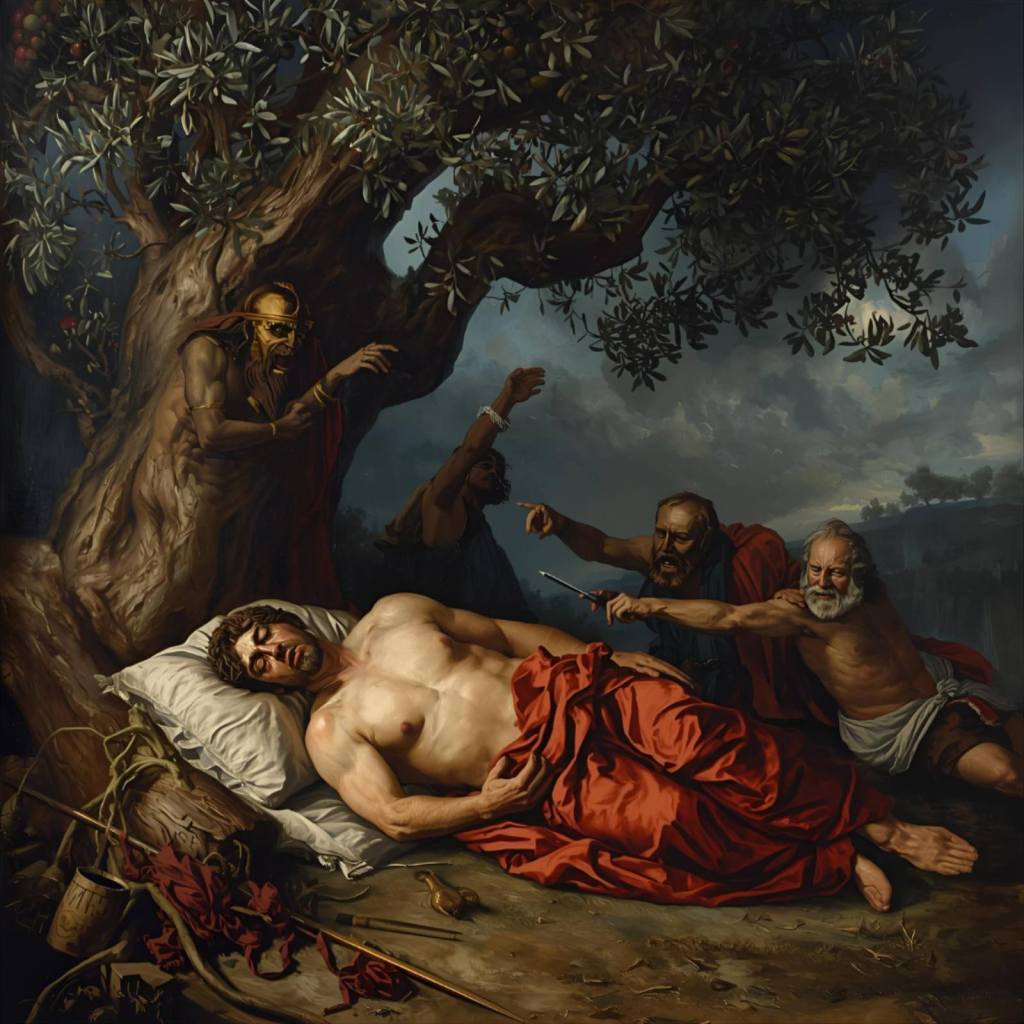
(EXCERPT FROM SYSTEMIC ARCHETYPOLOGY)
17.
The subject is left to wander alone in the wilderness of narcissistic dominance. He no longer has a life sector (at least not objectively). The entire life sector now flows into him. The subject himself and his body turn into symbols of the life sector and its objective value. No one recognizes the sector (or rather, all the objective, potential and future achievements that the subject defends with his life) and the power that the subject has in the orbit of the sector, and therefore no one accept his tangible privilege. His dispositional posture has no power to convince or dissuade. The initial position is a stain on his authority that spreads after each neglectful action of others, although everyone anticipates his enormous spiritual dimensions. The great opponent overshadows the subject even in the eyes of others who were “easily overcome obstacles”. In his absence, one returns to normal, but the heart continues to feel the countless daggers.
The subject guards the sector and its “materials” with a stinginess, fearing that anyone to whom he shows them will devalue them. Experience can no longer deceive him. He takes them with him as a priceless treasure, in the hope that they will help him cope with the merciless wilderness. He looks at them with the passionate eyes of madness. Their diamond luster is the very essence of the temptation to clothe them in a new divine garment. Passion ignites his mind, and concepts of salvation begin to form in and penetrate it. This bittersweet situation encourages the subject to reflect on the expanse of dispositional activities and its essence. So, no matter: 1) what the nature of the life sector is, 2) how the subject should act to save his primacy in the sector and the sector itself, or 3) whether he can transform the challenge into his own benefit (which includes the upgrading of the life sector), he always “lives” in the following metaphysical constellation. The insights that follow will show him most reliably, perceptibly and comprehensibly what it means to be being-there.
The consciousness of the subject active in reality is divided at the same time into three equisistent representations. The first representation reflects the bodily presence and posture of the subject in existence and his psychomental self-positioning in a certain ecometric formation. The second representation actualizes some experience or idea, that is, in it certain contents are mentalized that have no connection with the present and that have a technical advantage over the bodily presence of the subject and the dynamic modifications of existence. The third representation is a purely immanent-transcendent field, or ecstatic psychic immediacy in which potential objects of interest can be formed.
All of these have a phenomenological context and depth. They are not just empirical experiences, but empirical experiences caused by powerful intuitive states. The subject does not first anticipate the three representations psychologisticly, i.e. does not transform them into affective potentials that establish a serious connection with consciousness. He equalizes and homogenizes them in the pure energy of intuition, drenches them with it; distances them from consciousness and the sharp affective nature as far as possible and transforms them into some dull and heavy ontological substance that depends only on itself and elevates him in a pseudo-mystical way.
The fact that the subject has a being-there does not mean that it is located only in one place in cosmic space.1 Its being disperses and connects with the three representations through three potent, neutral and informal states. Its central being is a being-there, which identifies its phantom emanations, or epitomes, with each representation separately. It is a coordinating core that guarantees that the beings-at-their-representation and the representations will be equistent and have equal value. No matter which representation the subject will give priority to, no matter which being in which representation he will activate more than the others, his integral and triple representational state will not waver in the least. Each being remains with its representation in order to ensure the connection of the representation with which it is identified with the central being. A similar structure, with cognitive rather than ontological foundations, was proposed to us by Sartre when he explained how consciousness is divided into its functional correlates. But this ontological-psychological structure of representations and dispersed being can be severely shaken if the subject gives too much priority to at least one of the beings-in-their-representation and the representations-in-which-the-being-is-nested. The subject must constantly balance the introspective and perceptual focus so as not to distort or destroy the layered tripartite structure. If he fails to create homeostatic conditions for representations and beings, the subject will injure the central being, and with it, himself as its manifestation which is constantly exposed to evaluations.
He, the subject, can choose the bodily presence and the pathognomy of his posture. Or he can focus on the phenomenon-with-appearance isolated in the mind, consciousness and imagination, thus weakening the awareness of his own presence in the present. Finally, he can activate the mental forces as such to form a gestalt-field that he will fill a priori with consistent structures and grotesque sketches, thus devaluing the given mental contents. The subject doubles the reality of bodily presence and self-awareness in consciousness. This does not mean that the doubled reality overlaps with an isolated mental actualization and remains permanently fixed to it. The actualized double begins to live its own life, detaches itself from its extensive center. However identical the first representation is with the reality in which the subject exists and in which his body manifests, it acquires independence and can be considered in one way or another independently of reality and its true imprints. Only under this condition can there be a central being and the central being can disperse into individual beings located in their representations. This is how a diachronic distance is formed, which separates acute psychic time from time organized metrically. When bodily presence, its dynamics and manifestations as such are separated from the central being that has its beginning in the doubling of reality, at the same time the two forms of time (metric and acute) and the three types of representations are distinguished. In this way, each being-in-its-representation threatens to overshadow the other being and its representation, regardless of whether the subject moves from reality to intuition, or from intuition to reality. This potentiality is the first feature of entropic possibilities.
The first dispositional challenge for the subject is not to transform himself into a being-there. He can “transform” himself in that way and initially meet the basic criteria, that is, he will establish an initial homeostasis between beings and representations. But soon, the structure will begin to distort, its segments will begin to awkwardly shift to different places. The subject will not know what to fix first. Some beings and their representations will penetrate the field of other beings and their representations. The doubled will interfere with the activity of the pure transcendental-immanent field. The first is too rigid, the latter too flexible. They simply will not find a common language, regardless of whether they can be connected associatively. At first glance, intuition can give immediate meaning to any pure anticipation. But intuition is also powerless if the meaning is not connected to a given or potential contextual whole. The isolated phenomena-with-appearance (which is in no way associatively connected to reality) will penetrate the doubled content, and will relativize its framed context. The pure2 immanent-transcendent field can swallow up the remaining beings-in-their-representations like a whirlpool with its immovable hyperreflexive point. Or it will cling to segments of the phenomena-with-appearance, and will turn them into objects of absolute hyperreflection. The subject will not be able to bear this chaos. He will completely return to bodily presence with consciousness and will fixate on reality as it is. This will only bring him bitterness, because it will be worse than the worst impasse. In such chaos, even the ventral and dorsal functions of attention will not be able to find their way. They will not know which end to grab. Instead of the ventral function coordinating the immanent-transcendent moments and movements, and the dorsal function arranging the visible mental contents, manifestations and dynamics, both will be trampled under the feet of the agitated elephants called representations-that-contain-beings and beings-in-their-representations.
Therefore, it is not a problem that the subject does not have the capacity to transform himself into a central being, and to split into beings-with-their-representations. He is inexperienced and cannot achieve that the representations and beings mirror each other without disturbing the perfect and divergently arranged unity. Beings and representations must not only mirror each other perfectly and without inappropriate interference with each other, but must also be in harmony with the subject’s life goal, that is, with his visions of the possibility-of-being-great. These visions should discipline the beings and representations, educate them to think with one consciousness and to follow only one goal.
Each of the three representations contains the being of the subject in different ways. The doubled reality that can be introspected modally contains the subject literally and is entirely centered on his presence, despite the fact that the subject is in a certain existential context. The arbitrary or reminiscent phenomena-with-appearance focuses more on the contexts of greatness associated with the subject than on the subject as such. Finally, intuition, or its transcendent-immanent manifestations, equates the contexts of acquiring greatness and dispositional self-manifestation with the subject’s “megalomaniac” personality. By a being that belongs to and symbolizes the subject, and is identified with a certain representation, we mean not only the subject as a bodily monad, but all the associations and contexts related to his possibility-to-be-great.
Also, the three representations differ from their contents. They set the tone of the content, create certain constructive frameworks and rules of shaping, typologize it in accordance with the elements that have priority in them. Moreover, representations and their beings can be harmonized, identified in a certain aspect, and overlap if their segments are coherent. For example, the phenomena-with-appearance may contain a bodily posture and a subjective manifestation that belonged to a certain reality, and are now transplanted into another, perhaps fictional, perhaps current, existential and dispositional context. Or the subject may attribute the current context to an imagined posture that the subject has never tried on himself.
The great adversary (who is also a conditional adversary because he is a relative of the subject) humiliated the subject and unconsciously expelled him from the realm along with the remnants of the life sector. But the subject did not focus on his modal presence-in-the-world because his life sector had failed him, but because he was startled by his own passivity and inferior observation of risky-favorable events. His powerlessness in a given circumstance prompted him to reflect on his habitus, status, and ethos in general circumstances. The wilderness of dispositional apparitions intensified the awareness of general circumstances. The possibility-to-be-great is present, barely surviving hidden in the cage of the segregated life sector and its broken “artifacts.” But, the remaining pieces only remind him that others have taken everything he holds dear and demonstratively torn it to pieces at his feet. Furthermore, the subject has created a representation of the relationship between his present identity and the general circumstance, but he has nothing to connect it with and nothing to identify it with. He lacks an illustration that would give him future directions related to the meaning of the important representation. That situation is a dizzying and unbearable contradictio in adjectio.
18.
After many turbulent searches for orientations and turning of familiar experiences upside down, the subject finds a mythological profile of a hero who is in a situation similar to his.
He is also deprived of what, at least according to him, is proof of his greatness and an object of merit, which confirms that he has an extraordinary subjective greatness that encapsulates many achieved sequential greatnesses-within-reach. With the unscrupulous and insulting gesture, his ill-wishers not only deprived him of the ultimate symbol of glory, but also degraded the fact that he is great beyond measure. In the hope of regaining the “ultimate proof of his own greatness,” he tries to reassimilate the object of merit, so that the concrete return and the concrete object find a convenient and equally sensational replacement. The hero is Ajax with his bloodthirsty delusion and lustful vengeance. We consider the semantic structure of this bloody process and its irrational motives exhaustively in another closed and self-sufficient system of relations. After committing the heinous deed, he retreats, then commits suicide, while pieces of the scab of madness falls from his conscience and cuts through his already butchered being like heavy swords.
In Sophocles’ tragedy, Ajax’s suicide occurs behind the scenes. The subject fills this void, even sacrificing the dynamic contexts of the drama, to create a tense circumstance that grows slowly and torments the hearts of the witnesses. While imagining this improvised dramatic segment, the subject not only distorts the tragedy productively, but creates the conditions for the possibility of identifying with the disgraced hero through his own improvisation. The piece in which his endowment gave coin will enliven the active ratio of representations that constitute being-there.
Ajax rests under an olive tree. The elegant canopy bears leaves as small and delicate as the poet’s profound devotion. The trunk is like a folded water towel, and at its base as thick as a stretched and swollen dough; it has a terribly bleached shape, and yet it is inexpressibly lovely, like the wise-looking body of the old man. As he falls asleep, Ajax sends away the fresh morning. Unconsciously, he will meet the infernal midday. The short-lived coolness of the shadow in the fields yellow as embers deceives him as he relaxes cautiously. But its magical allure that forces sleep has powerful, contagious allies: the meek sheep that move to survive, their bristling woolly monads that tremble silently united like the sea, and the melodious sound of the waves gently splashing on the distant shore. Like a mother who strings a swing, they make the heroic mind revere and surrender to a summer dream. Now the rustling music of the waves intensifies the effect of the collective sheep’s movements that induces sleep. Their gentle, impressive and periodic surge fights with the movement of the calm sheep so as to stimulate the general harmony. But it does not do this to wake Ajax, but to add its own mastery to the perfect recipe for falling asleep. Their seductive power is so harmonious that it cannot fail to reach its goal. He does not know that the more peacefully he falls asleep, the more phantasmal and difficult to bare will be the naive enjoyment in which he engages like an ignorant shepherds.
Native nature has subdued the most stubborn of heroes! The sun’s rays drive away the fearful shadow from his forehead, which is stretched by a feeling of heavenly auspiciousness like an army fighting for a strategic plateau. The first heat waves fuel the revanchist reverie that resurrects the painful memory of humiliation. As he thought in half-sleep how he had allowed the three unrighteous man Odysseus, Agamemnon, and Menelaus to toy with him mercilessly and trample upon his military feat, the cruelest rudiments of memory burst forth into his oneiric imagination. Soon after, the heat conquers the heroic forehead and scorches it with imperious force. The more strongly the hot tide spreads over the body, the clearer and more vividly the adequate whole of memory is formed; the more easily the fragments are assembled into a long-lasting and tormenting sight. The dry Aegean wind begins to churn the sea more and more fiercely, transforming it into a cataclysmic mirage. It seems to match Ajax’s somber mood. Its action is sarcastically absurd: with his airy wings he deliberately does not reach the damned resting place, because if it weakens the high temperature, it will not be able to identify with the mood that only it causes. Now the cute dynamics of the herd have turned into collateral damage, into a pitiful atavism, neglected by the sea waves and their aggression. The sheep are not an object of interest because they no longer exist even as a representation in his closed eyes. And the arrogant sound of the splashes – which Ajax perceives as the slaps of the triple heroic deception that cannot be corrected – testifies that the solipsistic rhythm especially affects the unconscious mind. Every lover of swimming has felt the poetic-oratorical ambiguity of the sea waves on his own skin. When he stands fearlessly before them and confronts them, posing, they beat him in the chest, as the orator does with the hesitant being of the listener. When he jumps up to meet them in a friendly manner, they drag him into the creepy darkness of the depths, like the poet who paints the horror of arbitrariness that pushes us towards risky life decisions. Similar is the relationship between the music of the coast with its gentle seductive pathos and the intrusive crash of the raging waves. The sound of gentle seduction is heard through the piercing impact of the waves. But it is a bait, which will eventually redirect the subject towards the terrible associations that the crash itself gives rise to.
Heat is hallucinogenic and destructive. That is why it encourages the vulnerable reverie to be creative in a special way. The pain caused by the red burns that the fiery ether inflicts on Ajax, and roasts him as if in an oven without telling him when it occurred and where, is identified with the insult that his former comrades inflicted on him. His physical endurance works against him. It relentlessly keeps him in a solid sleep and does not allow the rigorous pressure to penetrate and abolish its spells. Perhaps the gods Aeolus and Apollo have joined forces to steal Athena’s “feat” and put their own stamp on the madness that will manifest itself as reactive aggression. Everything that insaniam adducens (brings madness) is unspeakably creepy. Apollo seduces Ajax and lulls him to sleep through the sacred music of the sea and the swaying waves so as to shield his soul from all influences of the heroic consciousness that protects it from perfidious injuries and direct attacks. Aeolus sends him the winds to intersect with the hellish summer heat and press him until his soul, exhausted and tormented, gives birth to the most terrible phantasms. Aeolus coordinated with Apollo and advised him to turn the sun towards Ajax and place it in a suitable place to chase and hold the saving shadows, so that Aeolus could occupy and cover Ajax’s muscular body with the hot winds. In return, Apollo taught Aeolus to play on the sea with his windy hands and gave him the notes of the notes of natural sounds. They cooperate lively, courageously and skillfully, and thus enable nature to show unwavering power and to provoke unceasingly. Although they govern nature, it has its own powers: it imposes and forces upon consciousness the imperfect image of humiliation by attacking the soul and through it – the imagination; transforming the painful memory into an immovable terrifying object. The more solid the morbid image takes shape in a mind that is unaware of reality and surroundings, the more strongly the imagination is inflamed and the more stingily it embraces its own image of humiliation. It seems that Ajax can think while in a state of sleep, but his thought is nailed to what the imagination imposes on him. The image of humiliation not only torments Ajax, but also forces him to become unconsciously vaingloried, that is to desire revenge unconsciously. That is why he becomes conceited. Thus is born the wrathful demon, protector of pride, who imagines that he shines ravishingly because he clothes himself in the disturbing cloak of absolute self-control. Ajax experiences vainglory as a form of righteous commitment based on to the urge to purify and justify egocentric superiority. This is his sin, his righteousness, and his judgment, the successful or unsuccessful realization of which he will sentence himself and his enemies, thus assuming the role of the Holy Spirit and abusing Its power (see John 16:8).
External nature sustains itself high in the bosom of its own power. It is ready to withstand any entropic pressure only to squeeze the soul and force it to concentrate absolute on the formed representation, which is now segmented, now manifested in all gestalt unity, now combined. But it presses so hard that it deepens the bad influence of the imagined memory. The content of the memory is itself defective, which means it has a bad effect on the subject. The weeping soul, which cannot stand without the protection of the heroic consciousness, surrenders to the expansive influences, justifies revenge, confirms humiliation. It worsens the influence and effect of the memory. Memory does not change the context and content. But the wounded soul exaggerates the reminiscent circumstances and perceives the imagination as a cruel medium whose only motive is to abuse it, even though the imagination itself is thrown into the same infamous mess. Consciousness is active and present in the dream state, but it is automated and turns into a sign and container of reactive states and instinctive reactions. Because of all this, the soul goes wild like a martyr who is ready to die defiantly or to fight bravely just to end personal agony. In the soul’s unyielding opinion, the imagination is the executioner who sadistically dissects it in various ways, that is, by projecting unbearable segments of humiliation for it and in it. But any resistance only intensifies the cathectic influence of memory, the terrible possibilities hidden in anticipation, the dark outcomes that it does not want to imagine, but are encouraged by memory itself.
The heat is scorching the massive figure of Ajax mercilessly and persistently. Drops of sweat fall everywhere and from everywhere on his head, like a panicked crowd that knows that something terrible is about to happen or is already happening, so it rushes headlong towards ruin, thinking that it finds salvation. The waves follow each other more intensely and disappear one by one at the place where they crashed, or break from the rocks like scattered tongues. Their aggressive rhythm accompanied by hollow bangs and tiny growls is thicker and thicker. Although this destructive intensification of external influences does not disturb the dream as such, it changes the state of affairs in the soul. Nature-provocateur gives a new task to the heated oneiric reverie: to turn the enemies from memory into literally present persons that Ajax will face at last. Its agents, embodied in the raging elements, disturb Ajax’s sleeping being with the passion of a systematic sadist. Instead of waking him up, and the intense tension being a stimulus that will reveal to him the unfavorable reality and the storm as a random omnipresence, he will continue to unconsciously dream the memory and subject it to transformations, just as external nature, that is, the storm, abuses the soul. Until the cycle is fulfilled, this dynamic will be unbreakable. Ajax can dream something and experience it as a wonderful or terrible reverie that seemingly depends on his mood and will; as an attractive representation that he calls upon consciously and with great passion despite the fact that he is dreaming. Automatic consciousness forces the subject to refer to and react to the internal contents as if they were voluntarily accepted and consciously experienced affects. These reactions show how much, in fact, the dream and its manifestations govern him, and not he them. Now this dependence is taken to the extreme, although more intense and exciting events will occur.
The imagination and the fragile soul plant a modified correlate, to grow into the structure of the past and change it; in the past when the proud and unjust commanders of the Achaean armies, unworthy of being called heroes, disfigured him and tried to justify their crime. In the new version of the past, the occasional dynamics unfold at the pace of aggression that nature itself follows as it whips the soul and forces the imagination to change old experiences and exaggerate old facts. Physical nature completely controls the psychomental world of Ajax and imposes its character on the “immortal” events. Agamemnon, Odysseus and Menelaus play a disturbing satyr dance around him at the site of the committed injustice that tears Ajax’s heart from within in aeternum. Every wave that breaks into tiny drops from the sharp rocks of the shore and the brutal sound it produces are transformed through imagination into a fierce blow with a hand on the body and cheeks of the humiliated hero. With voices infinitely confident in the power of black sarcasm, they sing “Prophecies who struck you!” These are only sharp rustling of the wind that turns into a fiery wave under the desertic sun.
The double that Ajax projects within himself becomes furious, gives in to temptation, and begins to retaliate against his insolent enemies. All the proprioceptive senses that are connected to the physical body of Ajax are integrated transgressively into the movements of the double. Even the body itself is placed at its service. Ajax connects his own body with the double and its behavior. The imagined bodily actions borrow the gross materiality of the body, to become deeper in a hylomorphic sense. The concrete body anticipates the imagined bodily actions to enable Ajax to experience them more believably and to reduce the distance between mental illusions and concrete experiences. All that the center of the self-projective event, that is, the mental individuation of Ajax’s personality, does is to reestablish the high vainglory. If he succeeds in crushing the provocateurs, he will elevate himself to the point where he will feel how the “will to power” is transformed into the pure, immanent-transcendent power that he possesses here and now. Self-engrossment is the energy of unattained vainglory that is self-achieving while self-engrossment flows and grows. The spirit of tragic reality will fill Аjax with anger to rise above the pathos of the wounded ego. The will that associates with courageous action energizes the egocentric position of Ajax, whether the action is ideal, i.e. articulated or not.
The double swings at the enemies that surround him dynamically. He exerts all his strength to hit at least one of them with his heavy Cyclops fists. His blows are unnaturally slow, heavy and difficult to control. He swings in empty space and constantly misses them. They are like virtuoso dancers, they dodge him flexibly, and each miss turns into a poisonous arrow of unbearable mockery that pierces Ajax’s heart mercilessly. In his soul, Ajax is waging a bloody struggle, while in reality, his convulsed body occasionally shifts feverishly due to the seeming blows his double takes. His heart beats too fast, not because of the exciting tension and the anxious uncertainty, but because the misses prick his heart harder than the dance of the sarcastic demons.
The day is at its zenith and it starts to surpass. It is not even known whether the extreme heat encourages the representation of Ajax’s active and painful failure to shape, or whether the representation itself emphasizes the terror of heat. Meanwhile, the sheep, exhausted by grazing and the sadistic persistence of the summer hell, gather around the last piece of shade that recedes at the base of the olive tree. Ajax is surrounded by the dusty and snow-white flock, but the flock is low and cannot protect him from the infernal thermosphere. Not only is he unbearably hot from their proximity, their closeness to each other and their wool, but he cannot breathe in such a stifling space, filled with the stench of animals. This sublimated agony forces him to become more and more vaingloried, although he is in an extremely powerless position. His entire face is transformed into a symbol of suffering, yet the light of unbreakable pride shines through it. The double also does not surrender, although he makes no progress. In this way, vainglory is diffused and distributed in two identical media.
Many insidious factors have accumulated that butcher Ajax’s being. The ability to create unconscious associations between the dreamed and the real, encourages Ajax to identify the irrepressible amusement of the belittlers with the stench of sheep. The stench of the sheep and the even more disgusting activity of the unforgettable criminals, are like the sweat of the entangled combatants, which encourages them to perform a virtuoso triumphant feats against each other, from a position of perverse submission. Because of them, Ajax becomes furious under the influence of incited vainglory, goes crazy for the second time, wakes up with the body, but not with the consciousness. The awakening is somnambulistic, which means that Ajax does not abolish or transform the phantasmagoric dream, but grafts it on the circumstances of reality. The circumstances turn into pure media that coincide with what happens in the dream. His obsession is the same, its content also remains the same, but it acquires a simple material basis. The imaginary actions have real and elementary objects of interaction against them. The objects of reality do not match the objects of imagination in form, but only according to the necessary use of their individuations. The form of the imagined things and their hylomorphic texture remain as they are, reinforced by gross impressions, positions, substances and experiences from reality.
The multifaceted pressure has taken its toll. The last Ajax’s nerve has snapped. His vainglory does not tolerate failures and inaccuracies. It is ready to escalate things until he gets his way, at the cost of the most terrible decisions. It is not a hypochondriac, nor a perfectionist in natura: it is ready to fight for his rise in conditions where imperfect behavior lasts a long time and his victory is not presented in the most beautiful light. Ultimate helplessness forces Ajax to become insanely brave, furious and divinely precise, to act under the guidance of perfect apoplectic instincts, to get angry and not make mistakes. His nervous breakdown does not lead him to a hysterical outburst of helplessness, but provokes actions that resemble simultaneous lightning strikes.
Ajax straightens up like an omnipotent and soulless god, irresponsible, blind to the consequences he will cause. He cannot avoid the blows, but he no longer feels them. He cannot break the cursed dance, nor can he avoid it, but the ecstatic certainty that the hour is coming when he will crush the enemies helps him forget that he is missing them. This position of his and his anticipation of ensuing action are logical symptoms of proudly rampage. Suffering has bathed Ajax in the dark passion of self-engrossment. From somewhere in his soul the voice of mindless ecstasy cries out, pierces him and his double and says: “Insults have hardened my will to power. I will break down the shield-bearing conscience that restrains all self-aggrandizing efforts”. A similar aporia gnaws at the mind of the god-fighter. Every sincere god-fighter must say to himself, “I was an atheist until I realized I was a god!” His ferocity towards God is a measure of his subconscious belief that he is God. Ajax worships himself at the expense of his enemies. This is where his courage and the will for revenge come from.
Ajax heads for one of the sheep fearlessly, as the master of fate, to deal with the enemy it symbolizes. It symbolizes him as accidentally as Ajax chooses her as his medium. He demonstratively breaks the neck of the peaceful sheep in his immediate proximity. Rage has torn him from the position of sleep, but it has not destroyed the dream itself. It helped him break the magic circle of failure that he experienced hypersensitively, but it did not save him from the bloodlust that turned action into a slave to madness. The dream state weakens the terrible and irrational effects of rabies. If he had been furious and awake, Ajax would have killed the sheep, prompted by internal states and impulses, even if he knew that they were not his enemies, just to compensate for the unquenchable insult. The delusional substitution of identities shows the overpowering affective instances in a softer light. Somnambulistic rage is less irrational than rabies (which in this case denotes apoplectic behavior in a state of wakefulness) despite the fact that the imagined event that triggers somnambulistic rage is much more out of step with reality, than the perception of the subject infected with rabies of a psychic, non-pathophysiological and non-epidemic nature. The subject carrying a specific rabies accordingly perceives the targeted object from reality and reality itself, relativizes their obvious non-identity with the imagined target and the events of the imagination that motivate him to behave in this way; sacrifices their innocence and misalignment, because he surrenders completely to the destructive, i.e. apoplectic affections. Ajax imposes the imagined events on reality and behaves in coordination with them, although for him, reality is covered with a black veil and is a source of coarse sensory data that generally fit into his idea and materializes it through itself.
After hearing the sharp crack of the broken neck, Ajax, despite being awakened and already acting, opens his bloodshot eyes full of unrest. The first sacrificial sheep was not one of the main enemies. Ajax experiences the flock of sheep as a numerous enemy army in which he has difficulty noticing the position of the main targets. He dimly notices the malevolent dancers, or rather, the individuations of the provocative nature and prevailing memory. While he was being slapped and groped in the imagination, the surroundings were unclear. The imagination reflected only the most striking moments of the unpleasant interaction, the identity of the surroundings was not important. After Ajax opened his eyes, the entire performance acquired a consistent identity. Although he is surrounded by a bunch of enemies, he sharpens his inner gaze and clearly sees which of them are the most active and are making risky moves. The illusory demonic appearances of the unjust heroes now operate in the balanced circumstance of physical nature and its reality. Everything is as it has always been, only the herd suffers imaginary changes. These modifications, that is, taxonomic fusions of the imaginary and the real into each other, do not abolish somnambulism. While he slept, chained to one place, Ajax was irritated by the form of the other’s violent behavior. Now, while he is somnambulistically “awake,” i.e. active, he cannot bear the very turbulent activity of his enemies, regardless of the type of belittling. The form of their actions and their appearances emerge from the black projector of the imagination and is introjected into the lethargic posture of the sheep. The imagination invisibly penetrates the luminous, trajectorial, traveling, pulsating and interactive networks of the brain, it pierces the skull to realize its own conspiratorial initiatives. It takes on a hallucinogenic essence. It spontaneously embodies the armies and their generals in the random formation of the herd, spreads like a threatening shadow and erases the real image of the things connected with certain objects of interest. Ajax can absolutize the fixed group of objects and transfer it from one imaginary environment to another, or walk it from one place to another in the encompassed reality. This territorial flexibility in conditions of strict group selection reflects Ajax’s obsession as such. At the same time, he is insanely possessive because he believes that if he defeats the provocateurs, he will transcendently regain the irretrievably lost object of greatness. All these motives, impulses and perspectives of action feed his rage and transform it into madness.
He cannot heal his common sense until he has fulfilled the intrinsic task. On the other hand, once he realizes what he has done, he will not be able to justify common sense, even if he restores it. The child who dives into the salt water of the sea, pretastes it, briefly experiences the substance of madness, is a short-lived victim of its panic manifestations. While diving, the child has no visibility of his surroundings; the environment turns into a dark watery abyss, which extends deep below his tiny body. It is a dark-blue infinity that occupies spatial dimensions that will crush him with their creepy size. Or he immanently imagines that the all-encompassing watery darkness is the habitat of a huge underwater monster that is coming to surround him. The monster is so large that it will fill the entire space with itself. He does not know what frightens him more, the terrible appearance, what it can do to him, or the proportions of its ugly body. All these factors mix and clash with each other in his imagination and force him reflexively to emerge from the water and flee the place. He will become so absorbed in the contents of the imagination that he will lose consciousness of how harmless his location is. After he emerges and opens his eyes, the bliss of the Mediterranean landscape comforts him, because its healing images covers the soul and refresh it from the experience of the imagined leviathan terror. Thus the child is convinced that the images that infected him and filled him with psychotic tension are illusions that can be recalled. Therefore, he returns to the cheerful play on the shore, as if nothing had happened, although in his heart the trace of permanent horror remains hidden.
Ajax is not so lucky. He is trapped in the delusion whose solutions he must realize. He kills several sheep using various physical violence and inflicts mortal wounds on them with his sword and with moves that he would use only against the strongest opponents. Dynamic rage is a materialized continuity of the will to power directed towards the phantoms that co-shape and segmentally transform reality. Madness encompasses delusional action and imaginary projections hallucinatorily displaced into reality. It is not just an outburst of vainglory that can no longer tolerate defeats, failures and humiliations, but is the highest expression of psychomental tension. It also represents egocentric subjectivity, which is exalted, passionate, transformed into a force equal in depth and intensity to wild enthusiasm, only it surrenders to the states of inferiority and at the same time, upgrades solipsism, self-sufficiency and complacency: it comes out of its own skin and encourages the subject to act destructively in the name of inferior states. Ajax is extremely bitter and angry, even while feeling like an invulnerable god, but somehow manages to consolidate these states and unite them with the affects of grandiose narcissism and with the feeling of unwavering greatness. Madness and rage are united in a single affective entity. They are the last phenomenal option of psychic activity, a sublime instinct that blinds Ajax to everything other than the necessity of satisfying bloodthirsty urges. In his case, vainglory does not coordinate madness and rage to balance their manifestation, but roughly unleashes them to extract maximum benefit, sacrificing articulation to pure courage, just to overcome the reality of the disturbed disposition.
Rage can manifest itself as an objective element of some behavior, for example, in childish mischief, or as a powerful effect resulting from a harmless outpouring of anger. Madness is an extremely irrational manifestation, or a complex of manifestations, of character that can take many forms. And vainglory does not necessarily arise as a consequence of an injustice committed against the proud, so that he directs it at the object that he considers an obstacle (which manifesting himself obsessively) or as a benefit that compensates for the damage (thus manifesting himself possessively). Vainglory can arise as a result of pure pride and secret enjoyment of egocentrism and be vaguely possessive and vaguely obsessive. It always strives to establish homeostasis between the manifestations of grandiosity. Rage, along with eccentric madness, is an obstacle that must be overcome in one way or another, must be regulated within the framework of the megalomaniac system. Rage is a hyperdynamic and most aggressive form of madness, it is its most unrestrained sadistic subcategory. It is a manifestation of grandiosity that gets completely out of control which is not limited to ego-maniacal ceremonialism. Vainglory cuts off such outbursts at the root. It is uncharacteristic for the vaingloried to simply release wild affects for his benefit. It is a forced and desperate solution.
Ajax emerged from the state of catatonic impotence, that is, he improved his imaginary action by transferring it to reality, by simply starting to kill real objects. But he still lives in a delirium, absorbed in the memory that he distorted with bias and is prompted by physical nature. Accordingly, if we compare Ajax with Prometheus we will find drastic differences within the complex of similar phenomena. Prometheus was suffocating with revenge despite the fact that his vainglory was in place, sober, aware of its psychological calling. Rage roared from his soul to be released, which in the end it did, to the misfortune of vainglory and its “ethos”. Consciousness, obsessed with the urge for revenge, fought the outbursts of anger, but gave in to temptation. The unconscious sent him reflections that corresponded to the irrational possibilities of liberation from the shackles. It was an echo of the rage that wanted to go out into the world and serve Prometheus at the expense of vainglory. But the stoic character of vainglory kept Prometheus in his consciousness. Vainglory wanted him to win elegantly, his feat to sanctify articulated courage. Therefore, he could not sink unquestioningly and uncompromisingly into the unconscious manifestations of irrational liberation. Imagination projected for him pure visions and unrepresentable phantasms, but it could not bribe indomitable vainglory. The enemy of Prometheus was present and personified in his servants. Therefore, every attempt by Prometheus to build an imaginary world that he would project onto reality, in order to satisfy the appetites of aggressive inferiority and reactive aggression, was met with a wall of brutal obviousness. He is stuck in a homogeneous armor of phenomena fused into one another whose structure he cannot break. The obsessive need to free himself and take revenge had to be satisfied with the explicit conditions of his high megalomaniac character and the immediate existence that limit the excessive ventures of imagination. Prometheus is not left to himself like Ajax, in the infamous wilderness that waits for the right moment to awaken the most terrible bloodthirsty fantasies that drive the victims mad. The feeling of injustice done to Prometheus is transferable, it does not apply directly to him, but to the “socius” he wants to raise from the mud. Therefore, his imagination cannot become so sick that it begins to produce insane projections. Who knows, perhaps under the influence of such imagination and its agency, Prometheus will have managed to miraculously and insanely break the chains. But the very thought of the injustice that the supreme god is doing to him and to humanity, and the rage that arises from it, are like a drip system that finds its way to the pre-stabilized structure of the soul, and then slowly makes its way through and transforms it. Rage electrifies vainglory, inflates it, helps it not to exhale quickly under the supervision of the awareness of its own refined role.
Rage and vainglory indicate how, in the paradigm of power, power struggles with its own “thermodynamic” challenges. Prometheus is as bloodthirsty as Ajax. His nascent mood signals this. The rage that grows in the soul corrodes the soul like drops that fall on a solid stone. It is the most characteristic energy of the inner Promethean rebellion. But until it conquers the soul, it is a half-hearted impulse, just like the bloodthirst it contains within itself. His obsession with revenge plays out in the field of having consciousness about the nature of things. He is not possessed with the irrational strategies of rage that arise from his obsession with the drive for revenge. There is no representation of the unconscious, that is, an unconscious anticipation of the determination to free oneself, which can impose itself on the exterior and reshape it. Possession in Prometheus plays a condensing role. It connects the hostile environment (wherever it may be) with his primordial urges. Ajax, in contrast, has arbitrarily connected the hostile environment with the reality in which he finds himself, and has united the two worlds in a single delusional phantasmagoria. Prometheus does not delve into the darkest depths of the soul in order to bind himself irrevocably to the synthesis between two objectively opposed worlds. On the contrary, he works his way there in order to balance his goals with objective circumstances. Unfortunately, forces await him at the bottom that he cannot resist. Rage sets its traps, outplays and overpowers vainglory, thus making it impossible for Prometheus to escape from the impasse calmly and intelligently, read through articulated courage.
The atmosphere in which Ajax’s rage is formed gives ego-maniacal manifestations unlimited freedom. At first glance, Ajax seems to fall asleep and flee into the anamorphic worlds of the soul to evoke the potential of unconscious representation. While he settles down for sleep and while he falls asleep, he transforms vainglory into absolute object of his own fixation, or in other words, into a psychologistic potency that will bear the juiciest fruit. It is the cognitive-psychoenergetic basis of all appropriate imaginary processes. Elegance is its innate and predominant feature, which automatically distinguishes it from pride. Its simple core will allow consciousness to penetrate the anamorphic depths of the soul, to reconstruct the unconscious and to extract from it a representation consistent with the challenging circumstances. But Ajax’s vainglory will experience a more tragic fate even than the vainglory of Prometheus. The rage, the bloodlust and the chaotic consequences of the slaughter will confront it with the symbol of its perfectly masked and primordial inner states. However, before that, vainglory will pave way to practical madness and its ego-maniacal phantasms. The killing of the first sheep reveals a rage that has been growing for a long time in the bosom of the soul. The further the worse. It will sharpen so much that it will resemble a perfectly precise shot guided by the hand of wild and elemental hypersensitivity. All subsequent shots will become echoes equal in power to the first, grandiose tremor. Prometheus’ rage grows and manifests differently. Because he cannot allow himself to act freely, his rage deepens, turns into a voracious crater that is ready to swallow all of existence. Once he releases the rage, the rage will not cut existence in half like an oblong blade. All the “misanthropic” depths of hell will be imprinted in its melody, it will be a scream that shakes the foundations of the universe. But because its powerful mimicry will remain without consequences, the rage will turn into a penetrating and equally ineffective reflection of potential disasters. Its real, accumulated and overloaded energies will burst into the void like a star dying in a distant galactic system.
Vainglory is a psychologistic state that smolders in Ajax and was born at the very moment of his disenfranchisement. He is vaingloried because he attributes to himself in advance the articulate courage, the elegant opposing, the clever and quiet strategizing, as the qualities that most strongly emphasize his personality. Only in this way can Ajax’s behavior, to which we will now return, be initially explained.
By directing himself towards external objects travestied into anti-heroic apparitions, Ajax shows and confirms that the acts are perfect thanks to his delusional conviction that madness does not project, but presents things as they are. Therefore, rage continues to play a life-giving role. Ajax hastily cuts short the suffering of several more sheep. The mercy he shows unintentionally and unconsciously to the wrong victims is as blind as the imagination in a dream that intertwines with the environment of provocative physical nature. Ajax chooses which of the oneiric imagery and its somnambulistic projections to unite the segments of reality with. Vainglory demonstrates an unerring instinct when it comes to the atmosphere it must create to enable itself the most appropriate and impressive occurrence. If this means sacrificing elegance to transparent rage, it happily agrees to such a thing. In terms of general blindness, Ajax repeats the fate of Polyphemus. Odysseus blinded Polyphemus while he was sleeping soundly, and he slept because Odysseus, aided by his companions, had drunk him to easily blind him. Something similar happens to Ajax: the suggestive sunlight and the perfidious roar of the waves put him to sleep in order to resurrect the terrible memory that will overshadow the peaceful reality. Sleep is the brother of blindness from a certain perspective. It creates an atmosphere for the formation of hybrid representations and gives priority to unconscious reflexes that forget what they do not want to see and transform what they can to satisfy the dreamer’s appetites. Dream is the hyperactive and extroverted twin of sleep. It becomes the throne of vainglory from where, through madness and rage, menages the hybrid representations of the unconscious that alters present and past realities. Vainglory is the hand, madness the match, rage the fire. The first one only needs to swing and burn the world. In this case, blindness is the worst trait. The swing will be seemingly elegant and full of the sense of perceived possibilities, while in reality, Ajax will exaggerate the subtle transcendent current of ego-mania. The subtle ego-mania will fall victim to the unbridled infatuation and the will to destroy that inspires him to take shrewd revenge at the appropriate moment. The harmonious expression will turn into its opposite in an hour, although it will not change anything in its structure, but will emit a suspicious and unpleasant anticipation that will say everything about the prevailing impressions hidden in the self-identical and good-looking expression. The moment and the impression of shrewdness will quickly fade, because the procedure will be overshadowed by a spirit different from the initial one, a spirit that struggles with all its might to emerge and show who has the real power. If Ajax is unable to see how physical nature is castling, which means, is replacing real things with imaginary ones, how will he deal with the vainglory that alienates itself from its own essence and does not respect its standard manifestations?
Every action sequence reeks of an absence of power over oneself, even though Ajax directs his anger and focuses it on chosen objects. The somnambulistic actions are automatic, regardless of the fact that they represent the absolute will that gives the impression of knowing what it is doing and what it wants. The demonstrated will is only a mask of automatic processes. Ajax lifts one of the sheep above himself with his hand, stabs it with his sword from the bottom up, and throws it into the immediate proximity, all covered in blood, silent from pain and with a half-extinguished shine in its eyes. After that, he cuts several more with masterful strokes. He does everything to get to the central figures who are constantly in the background and from there strike him in a paradoxical way. They hit like an offensive thought or a painful memory that are pure echoes that erupt from the transcendent depths of the soul. Ajax kills the sheep, confident that the turn of those who most deserve the hot steel will soon come. But as he thins the ranks, the enemies retreat more and more rigorously into the background. In the soul and imagination, the overwhelming dynamic manifestations of the main enemies stunned Ajax. He was frightened to the point of autosuggestive psychosis by his childlike powerlessness, but his character did not waver. Now, in the empirical environment and after their apparent appearances became tangible due to integration into the herd, their supremacy acquired a new positional form, although the dynamic moment remained as before. They reposition themselves but not systematically in terms of the physical trajectory they have to cross over in a certain period of time and in relation to the obstacles. More precisely, they transpose themselves specifically, abruptly jumping back and as if suddenly evaporating from pure air into the rear ranks. The killing of the front objects transfers them to the back to a more secure position. Ajax thinks he is defeating them while he is facing them in the front lines. But their personalities are like reincarnating souls that leave their bodies to inhabit other bodies. The objects that were their media give way to other object-media. Because of this, Ajax still feels like a newborn in relation to them, although vainglory has revived his psycho-bodily initiatives. But Ajax does not give up. He is determined to go to the end, to comb every row, observing the lucid law of sculptors: “The statue of the mother is inseparable from the statue of the newborn. You cannot keep the newborn floating in the air.”3 Vainglory is his mother. He places all his trust in her, especially when it seems that vainglory is trampling on its own codes of conduct.
Ajax carries out his plan with executioner’s precision and steadfastness. The pores of the olive tree are filled with the spilled blood. The splashed clots of blood flow through the furrows that curve sinuously down the trunk. Ajax has not only combed the irregular rows, but has exterminated their units until he reaches the last few rams, who are running here and there in terror and confusion. He approaches the nearest of the few remaining rams, and, furiously and without unnecessary effort, stabs it several times, wherever the instinctive outbursts of rage will direct him. Ajax exults because he believes endlessly that he has “taken the measure” of the first main enemy, while all those who quaerere verum (seek the truth) see only an archetypal representative of nihilism, who turns the ram into a symbol of weakness with which he wants to part ways immediately. Ajax cuts the second ram’s head off with undisguised contempt. He tries to cut the third ram in half, but his sword gets stuck in its spine. This triggers his extreme rage. So he grabs it by the neck as if to strangle it, takes out his knife, and stabs it several times smoothly and quickly. Immediately after that, he pushes it hard with his foot and kicks it fiercely, as if the degree of sadistic cruelty depends on whether he will regain the lost object of greatness in a transcendent way.
The first ram had taken on the “image” of Menelaus. The direct blows inflicted everywhere on its body show that it is the most relative, and even accidental enemy of Ajax, who interrupts and should be eliminated as soon as possible. The second ram had embodied Agamemnon, the blesser of the unpleasant outcome. Ajax tore off its head because he does not recognize Agamemnon as his ruler after what he did to him. The third ram, which ended most tragically, is the one and only Odysseus, the seasoner of insulting events. Ajax tried to cut Odysseus in half to symbolically separate him from the object of greatness. But objective circumstances once again intervened and justified the thief. Therefore, Ajax decided to eliminate him quietly and neatly. Having done so, he was overcome by feelings of superiority (the idea that after so much effort he had achieved the impossible), and he gave in to rage so as to magnify his vainglory and its subtle affective influences. Although vainglory manifested itself through eccentric categories, it handled them subtly.
Ajax exists in the mirage of the triple murder, which is adorned with the remains of mass bloodshed. Instead of slaughtered sheep and rams, he sees soldiers and king-generals. The kingdom of the solar heat collapses under the pressure of the afternoon eclipse. The waves calm down due to the silence of the evening hours and rustle like the trembling of satisfied passion. The hallucinogenic fever leaves Ajax’s soul, and abandons his consciousness and conscience to the empirical surrounding that has taken over the phantasmagoric role from the antagonistic imagination. As the judgment of reality approaches, so confusion flees with its tail curled. Consciousness is purified, and as a result, it reestablishes a rational relationship with inanimate objects. Ajax now remembers details that only a highly developed mind can perceive and explain. At first Ajax imagined his action purely in interactive self-projection, empathizing with it passively and exclusively in the soul. After that, he began to swing his sword in reality, even though he was still lying under the olive tree, completely absorbed in the circumstances of the soul. Each imprecise swing at the apparitions, after the sheep had surrounded him and while he was sleeping on the ground, took the life of one sheep at a time. The blows were not calculated ventures that took into account specific target objects, but arbitrary actions of an ambitious vainglory guided by the movements of the apparitions in the imagination. So ridiculously inarticulate was the connection between the order of reality and the events in the imagination at first. Physical nature forced Ajax to imagine the violent provocateurs and their flexible displacement. Then the sheep, also orchestrated by physical nature and seeking refuge from the heat, gathered around Ajax and urged him to extend the projection, that is, to adapt it to reality. Thus he continued to live the dream in reality. He became like a living dead man who sets out to confront the current cracks in his life. In order to organize the convergence of the imaginary and the real into a consistent whole, he had to add the Achaean armies, because before him was a quantity disproportionately greater than his inevitable targets. In other words, the imagination automatically regulates the disproportions, to allow the behavioral instincts to do their work without hindrance.
After the potentials of delusional action and thought were exhausted, madness and rage retreated to the depths of the soul with the vainglory that fueled Ajax’s ego-maniacal impulses. Ego-maniacal impulses are the immature children of vainglory, and vainglory is their unattainable ideal and source of life. Vainglory is the queen of megalomaniac self-perceptions and self-experiences, but it turns into a beggar in order to inflame their rebellion. Ego-maniacal impulses and megalomaniac visions are two sides of the same coin, just like ventral and dorsal attention, just like reflection and feelings, just like narcissistic concepts and egocentric affects. In between, vainglory prepared the ground for the mass sacrifices, then disappeared with dread as soon as the face of the terrible outcome appeared on the gloomy, dead and silent horizon. Ajax does not believe his eyes. The slaughter is too morbid even for his military taste. Woolen bodies and pieces of stripped flesh lie scattered, butchered and crushed all around the olive tree. All are soaked in blood like threadbare floorcloths. Deep wounds are visible in the thick cotton layer likе puddle of a stream hidden in thick grass. Streams of blood flow simultaneously from the decapitated corpses and the severed body parts. This sight depresses Ajax more than the absence of the forces that had exhausted and used up his heroic energy. The approaching night darkens the scene of horror. The darkness will intensify the prevailing impressions as the stars and the moon remain shining in the sky after the kangaroo Dohar rolled up the night like a carpet. It will happen in the style of the good old imagination that transforms darkness into a projector of primordial abominations. Through the first axial form of imagination, Ajax will once again prove that his being is infantilizing and abandoning the heroic essence. His sober mind cannot withstand the terror of the sight. Therefore, he falls to his knees desperately exhausted, catatonically confused, stunned in thought. His eyes are dim because his soul is overflowing with the filthy material that has clogged its extensive light. So much have his strength been burned by the impulsive servants of vainglory that Ajax can’t feel any guilt. He practices various attitudes that reflect concern in order to encourage himself to feel at least some remorse. In vain. The forces of vainglory peep mischievously from the depths of the soul. They are the energetic remnants of the quasi-luminous self-exaltation and force him to be quietly proud of what he has done, despite the fact that conscience at least formally prevails in his consciousness and being. Unlike conscience, which is only a mental projection torn from any living feeling, silent pride is an energy full of weight that Ajax feels unequivocally. Silent pride symbolizes the spiritual emptiness that whispers encouragingly to the fallen hero: “Be consistent and courageous god! Carry with you my burden, the burden of incurable emptiness. Let your power resist the wicked life for the last time. Kill yourself! Pull the last handle that will lead you to a ruin full of irresistible ecstatic experiences. Make the vow of ultimate delusion, where the best that can happen to you happens gradually and at the same time has nothing to do with the actual possibility-of-being!” The glint of irrevocable defiance passes across the surface of his eye like a fiery comet traveling across the night sky. Ajax stabs his sword in the stomach. He falls with his forehead on the yellow desert, full of connected and self-existent bloody shapes that resemble a chaotic sketch.
19.
The first significant realization that the subject gained while imagining this reshaped and recontextualized representation of Ajax’s delusional outburst is the following. Until Ajax got up and started killing the sheep and rams around him, he was wildly and enthusiastically empathizing with the inscenation, that is, became wildly enthused against the temptations within it. Once he had straightened up and boldly begun to cut up and butcher the innocent animals, wild enthusiasm did not cease to exist. It not only formed the standard solipsistic synthesis within its own framework, but also added stronger affects, such as the megalomaniacal need for self-assertion and the irrepressible and frivolous ego-maniacal urges. This realization is of crucial importance for the subject, because he saw that wild enthusiasm is not only a solipsistic attempt to experience power and its practical manifestations, but wild enthusiasm is also an inarticulate child of power, which has a large share in the concrete practical acts. Wild enthusiasm is not just a structure of affects that relies exclusively on representations of power. It is an affective structure that fits into any behavior that cannot articulate the urges to show superiority. It wants to equate the impression of discretion with its obvious insane states. Its contradictorily discreet attitude is a form of subtlety that can be observed even in the wildest dispositional endeavors. No different behavior and different impressions are expected from it: wild dispositional behavior is a form of action that coincides with the insane states of wild enthusiasm, which are forms of eccentric dispositional attitude. Hence, wild enthusiasm fits perfectly into such action. The conclusion is that it precedes power and is one of the key epitomic stages of its development.
This fact refreshes the subject. Now he is ready to move forward, at the cost of adopting wild enthusiasm, against which he had nurtured insurmountable prejudices. Knowledge not only erases hardened prejudices but creates a detailed picture of the benefits of changing the initial attitude.
Ajax’s representation of the transcendent reassimilation of the object of subjective greatness and the struggle with the enemies united in an indissoluble whole the practical structure of action, the inspiring oratorical structure of general narcissism and the psychoenergetic affective manifestations of wild enthusiasm. Their symbiotic relationship is formed in advance by the very mentalization of the given representation. Their core relationship only intensifies and acquires a slightly clearer character than at the beginning, thanks to the fact that the representation from the content of imagination has turned into a hallucinogenic projection. The subject feels so humiliated and wounded that he forgets what consequences Ajax’s unstable character has led to, and concentrates entirely on his ecstatic triumph; on the psychic and practical states of grandiosity. Another specificity inherent in this megalomaniac and ego-maniacal representation with a hint of inferiority is the following. Instead of general narcissism manifesting itself as a self-contained system of encouraging evocations belonging to Ajax’s subjectivity, it took up residence in the voices of the provocateurs. Instead of playing a purely constructive role, it was constructive in a transmissional sense. It had none of the encouraging exclamations of the schizogenic voices, but nevertheless the provocative note it introduced had an ingenious effect, if not on the outcome and articulation of action and experience, then on the display of courage. Ajax stepped out of the “comfort zone” and confronted his enemies in the most brutal way possible. Despite the fact that his action was delusional and therefore shameful, he madly encouraged himself to do what no one wants to even imagine. The provocations only awakened the world of self-aggrandizing intentions that had been sleeping weakly on the surface of his soul. Wild enthusiasm infected him with its stereotypical affects. All the blows previously inflicted, together with the blows inflicted on him now and here, helped to build this apoplectic machinery. But the transformation of the feeling of humiliation into hard-heartedness, of hard-heartedness into a passion for revenge, of the passion for revenge into the enjoyment of passion, and the enjoyment of passion into bias seemed little to Ajax. The prolonged blows intensified the effect of dissatisfaction. Therefore, to states of anger and annoyance full of obscure and rootless admiration, Ajax added ego-mania which concludes in the blind longing for the brutal elevation of the ego, and megalomaniac visions which are forms of sadistic dealing with annoying obstacles.
As the dramatic interaction between Ajax and the visions of his mind unfolds, the fundamental structures of the soul reveal some aspects of participation. The subject cannot help but marvel at the spectacle he has created. There, he is confronted with a powerful structure of practical action. The power of this structure grows in the eyes of the subject under the influence of the illusion that the unbridled manifestations of inarticulation are admirable because they are correlates of arbitrariness and supremacy. Action has a practical structure because it represents a certain material working-in-the-world. How many aspects of other soul structures will be revealed to consciousness and heart depends on how powerful an impression it will leave. Thoughtful movement, purpose, and concrete movement towards the goal have a profound psychoenergetic value. They are basic conceptual qualities, or categories, of practical action, which, in addition to raw action, indicate the other affective components of action. The soul empathizes with the action, monitors all the steps, catches non-standard manifestations and appropriates synergistic moments. Thus, it processes the practical action, and rethinks its relationship with the world, depending on the processing. In this sense, the soul, and more specifically, consciousness, are transceptive. That means, the depth and expression of the practical action predetermine the subject’s relationship to its structure, which hides the greater part within itself just as a colossal iceberg hides itself in the cold murky depths and shows the low peak. Practical action, as an extraordinary expression, leads the soul to gaze upon qualities greater than the superficial appearance of the material procedure, and respect them.
Ajax’s charge is not inarticulate in itself. Even his frequent misses are executed with style. It is inarticulate in the sense that it allows delusion to prevail over reason. Moreover, the chaos that Ajax leaves behind devalues every destructive articulation, if the one who perceives it is of sound mind. It is therefore no wonder that the subject is wildly enthused by the practical action of Ajax, or rather, he wants to have his brutal self-confidence, dedication and intransigence, and longs to realize it in his life. The subject approaches practical action selectively, euphemizes its monstrous character, reduces the bloody outcome and the bloody process to a few weakened dispositional and megalomaniac motives, adopts the sadistic spirit but not the degree of crime and the form of violence. This halved reception of Ajax’s action and its causes, manifestations and circumstances does not prevent him from getting to know the synthetic features of general narcissism and wild enthusiasm. He immerses himself in practical action deeply enough, even hypnotizes himself with it so much, as to see the subsurface connection of soul structures. From the terrible grandeur of delusional heroic action, the subject redirects his attention to physical provocations. Finally, he will pay attention to pure psychoenergetic affects.
Practical action (as material working in the world) is grounded in general narcissism. The very urge for revenge that looms in Ajax’s gloomy, easily predictable, and rapidly rising mood shows that behind the intentional sphere lie quantitative laws of human nature. They, “express quantities of measurable attributes and relations whose variables can be functions of other related variables.”4 The first part about the quantities of measurable attributes and relations applies to general narcissism. But the appeals of encouragement are causal and fixed, they coincide mechanically. The second part about the creation of variable formations coincides more with the stereotypical affects of wild enthusiasm that are grouped depending on the seductive representation. But each variable formation is also fixed, self-sufficient and closed in on itself, until it is swapped by another one grounded in a seductive representation with a special constellation. There is no interfunctional connection between the variable formations. But wild enthusiasm has a solution for that too. The stereotypical formations of the affects become the basis on which ego-maniacal impulses erupt. Even general narcissism joins in and adopts this logic. It uses pure megalomaniac visions as its own derivative. Thus, the subject not only takes an intentional attitude towards the seductive representation but also idealizes the representation, turns it into quasi-divine entity and into something that is revealed only to him. Moreover, he turns the affects into pure motives which, through the mediation of ego-maniacal impulses, acquire demonic power and influence.
All these structures merge and unfold transcendently in the actions and experiences of Ajax and infect the subject through his deep reception. Their trajectory does not extend visibly in time, although the subject feels its systematic flow. Each segment of the action is connected to the corresponding appeal of the general narcissism. And each appeal of the general narcissism creates an affective synthesis with the segment of action to arouse certain affects of wild enthusiasm. This basic description illustrates how their structural relationship develops. Each is a sequence of an integral cycle and represents a “flow closed in on itself”. As the appeals, actions and affects intertwine and build on each other, the cinematic circle closes. Each complementary event of this type is intrinsic to the incomplete teleological picture of things and completes the structural orders5. Moreover, all universal structural categories have a psychologistic function. Calls inspire courage to act, affects stir the soul to love action, and successful action yields the most substantial states of self-engrossment.
This series of individual happenings that constitute an event with a sublime affective configuration can be explained as a hybrid of machine and gestalt developments. The machine unfolding is diversified and flexible. Its cause-and-effect relationships are multifaceted, make dizzying exchanges, and form many diverse paths, tracks and nodes, which themselves contain systematic configurations. Their systematic configurations do not cooperate only with the segments with which they are factually connected. Gestalt unfolding is ambivalent par excellence. Every event in the machine coupling of dynamic relations is reflected in the extremes that coexist at the same time. The machine-systemic relations are reflected in immanence and transcendence; in pure statics, pure dynamics and pure inertia; in anticipation and in consciousness; in infinity and finitude; in the clear and the unclear; in the extrapolated and the compressed. The Gestalt is invisible mythical point that absorbs all contradictions and all outlined relations. A simpler and condensed version of what we have said is presented by Allport:
“It appears, therefore, that the attempt to explain structure through the customary time series of cause and effect is futile. Some other explanatory concept must be sought that will circumvent regressus and link up events in some kind of pattern. Explanations must lie in the approximate “here and now” rather than in the remote past. The only way to accomplish this seems to be to cut across the conventional and absolute “time stream.” One can think of time as the duration occupied by the successive ongoing processes and events of a particular pattern that closes itself through a cycle of operation.”6
This excerpt perfectly reflects this ideal state of this delicate systemic affairs. However, some things need to be explained further.
The basic description and its illustrative role have shown us how some structural categories complement others regressively: imagined actions complement appeals, the affects of wild enthusiasm complement imagined actions, articulated courageous action, at least that is what the subject desires to happen, complements the affects of wild enthusiasm. In other words, imagined actions hypothetically justify appeals, the affects of wild enthusiasm intensify imagined actions, articulated courageous action satisfies the bottomless appetite of the affects of wild enthusiasm. In doing so, the subject does not create a seductive or dispositional representation on which to base this causality. But causality is not regressive just because of that. On the scale of dispositional self-manifestations, appeals are first because they are the most abstract, followed by imagined actions because they are virtual. The affects of wild enthusiasm are third because they are purely psychoenergetic. Finally, articulated courageous action is last because it is an central element of the dispositional idea embodied in the world.
The categories represent the fundamental structures of the soul and are distributed into classes in accordance with them. They are configured in accordance with the self-dynamic predispositions of circumstances. Circumstances are at the same time subjective and objective. The common pattern of the categories can be determined only after seeing how the fundamental structures intertwine with each other and form the body of the psycho-affective and pro-practical event. This does not mean that the process is not predetermined by a fixed causality, rooted in its foundations. For example, dispositional action must captivate with its style and logic of development; general narcissism must harmonize the appeals, wild enthusiasm must organize the affects according to the segments in the seductive representation of dispositional action. All these perspectives of categorical manifestation in the self-sufficient structure must be harmonized with categorical manifestations in the remaining self-sufficient structures. But even if there is an imagined event that contains consistent dispositional actions, the subject must experience its unfolding acutely in order to be able to extract from the memory of it all the experiences related to the systematic and interoperable manifestation of the categories. The categories and their concrete symbols cooperate with the potential of dispositional inscenation directly and form interactive schemes. But in order to depict the scheme, the subject must describe the cyclical structure of collective collaborations. Thus, he will objectify the hypostases of the machine gestalt as he conceptualized its intuitive structure. By the way, we have presented several such dynamic structures, or interactive schemes, composed of categorical connections based on specific seductive, provocative, and dispositionally potent representations.
20.
There are four layers of categorical order. The first layer is the categories as such: the appeals, the imagined forms of dispositional action, the affects of wild enthusiasm, the articulated courageous action. The second layer is their ideal isolated constellations. The third layer is their connections and relations with the elements of the common system. The fourth layer is their objective manifestations in accordance with the inscenation and the categories of the remaining fundamental structures. If we imagine how these layers are constituted and connected with each other, we will easily imagine the elementary scheme of collective interactions.
The subject hits rock bottom. Once he has explored these depths of personal dispositional possibilities, he returns to action and becomes intoxicated by its mental presence as if it were an irresistible fetish. He experiences the quintessential action so strongly that an old vision flashes into his mind. He remembers retroactively the structure of dispositional qualities and potencies. He abandons the consciousness of the power of articulated courageous action and joins the ego-maniacal urges. After a while, he seeks another source of pleasure, and repeats the appeals in the correct order, as if playing with a stuffed beast or a puppet with strings. Thus action establishes a self-renewing economy. Wherever it begins to bind the categories and structures of the soul, from beginning to end or from end to beginning, action renews its affective power. The same thing happens, both if he imagines the dispositional event complementary and if he remembers the motives that prompted the event and his behavior. The very fact that action is the central moment of all antagonistic and dispositional events privileges it above the other potencies. It is like the central position in the empty space from which there is visibility over the entire horizon. The qualities of the soul and body and the objectivities in the inscenation and the real challenge always point to action, regardless of whether the action has an imagined form or is carried out articulately and courageously in reality. The remaining categories increase the impressiveness of the action and transcendently reveal its depth. They are incorporated into the complex dynamics of the representation of action and in the action itself, just as the mechanisms of intuition are incorporated into the cognitive centers that use them. Such intuitively recognizable impressions and qualities that surround and co-constitute the action enrich the inscenation and even more the reality that unfolds according to its taste. The existential expression of action and self-projection full of dispositional and agonistic events radiates these invisible dynamic systems. It becomes a pan-contextual whole that conceals the systematic moments as much as it reveals them. The inscenation and the actual antagonistic event reflect emotional states, affects, mental manifestations, mysterious moods, unconscious motives, etc. However, they are only individual outbursts of the systemic dynamics that take place in the background of the events and shape the events themselves.
Unfortunately, however delightful the bloodthirsty madness of Ajax that the subject reconstructed, it cannot inspire him to anything other than suicide, which according to the subject is scandalous and impermissible. Its power of persuasion also strangely weakens due to the landscapes of extremely delusional and exaggerated violence. He behaves imaggressively: the horrible sight and the primordial frustration that comes from the ambivalent qualities of the sight do not add to the frustration. The subject reconciles himself to the image of things as something that had to happen, does not angrily and constantly point out the things that prevent him from fully enjoying the inscenation and expects the inconveniences to be overcome by themselves7. On the one hand, he gets the wind at his back in one way or another, but this is not enough to overcome the given phase of his own development. On the other hand, the situation is saved by the fact that the seductive representation of Ajax’s madness opens up new constructive possibilities for him, because the representation itself is a construction that goes beyond the framework of all previous attempts to construct an arbitrary face-like image.
The subject took the basic elements of the archetype called the Ajax’s complex, or an ancient notion of the delusional substitution of identities mixed with the delusion of grandeur. The extreme antagonism, the slaughter of the wrong targets in an attempt to establish damage control, the self-aggrandizement that exceeds all limits of decency and moderation, the mood that is roughly mirrored in classical dramatic and mythic imagery, the essence of reassimilation, the object of greatness, and the victims of the animal world — all entered into the new model of the self-identical archetype. The circumstances leading up to the basic outcome changed, while the outcome remained the same, with the potential to connect asymmetrically with the subsequent events of Sophocles’ tragedy. This picture of things lacks Athena and her power to take the minds of others. She is replaced by the physical nature that manipulates Ajax’s initial psychic states. It is also not known what exactly precedes the “dreamlike heroic activities”. The latter brings Ajax’s pre-death situation closer to the myth and its mysterious life dimension and at the same time throws out all the given circumstances in which suicide and the descent into madness are intertwined. Thus, two old modes of the event cooperate and obey the need to produce a more sophisticated representation of the self-identical and archetypal drama. In the early Middle Ages, only dreams, experiences and visions that are connected with revelations of the afterlife were recognized as truly archetypal representations. But not every revelation was truly archetypal. It was supposed to meet the prevailing criteria that were reflected in certain stereotypical connections that run through every credible revelation8.
We have literally enumerated all the stereoscopic connections that make up the Ajax complex archetype. Every representation that is built on the basis of these stereoscopic elements and is modified without omitting even a single essential element is a matrix image of the self-identical archetype. If the representation is dominated by stereoscopic elements and connections but there are also significant changes and additions merged with other convergent contexts, then it is archetypal, to the extent that it resembles the core self-identical form. The stereoscopic elements change the impression of themselves depending on the medium with which they build a connection. For example, the influence of physical nature on Ajax helps to explain thoroughly the rise of a morbidly aggressive mood more than the gesture of the goddess Athena. If these connections change the self-identical form of the archetype by enriching it with implicit contexts, then the change is positive. If, on the other hand, they alienate it from the fixed synoptic logic of the archetype, they crush and hybridize it. No matter how sophisticated it may be, such an archetype becomes an element of a larger sketch of archetypal representations and loses its originality in the mists of multi-meaning and complex archetypal connections.
The basic elements and connections in the pure identity of the archetype are stereoscopic because they can be seen from different semantic and aesthetic perspectives that their synthesis with related circumstances, contexts and objects allows them. The general structure of elements and connections must remain largely the same, regardless of subjective motives, collective motives, life situations, the interweaving of circumstances, convenient internal modifications, the arrangement of stereoscopic orders. Any additions embodied in the changed arrangement of circumstances, the replacement of the main character by other characters and of one life constellation by another, the addition of moments that enrich the picture of things without derailing its deep axis are components of the matrix image. The less the core self-identical form is derailed, the better the archetype is noticeable in the series of events that may, but need not, be based on it and highlight it. In this sense, “the archetype and the matrix image bind the cumulative form of information that flows into the general structure.”9 The cumulative form of information includes all the primordial factors of stereoscopic connection, or rather, fixed stereoscopic elements, their connections and hypostases modified under the influence of additions and designed existential circumstances. The general structure, in turn, is composed exclusively of the basic stereoscopic elements and connections, which are configured in accordance with the synoptic states of the pure archetype. All additions and diversified distributions of the fixed elements and connections, in turn, relatively reshape the pure archetype and impose a matrix form on it.
There is no archetype that can be perceived by itself, if before that, a certain matrix image is not presented (by which we mean a certain archetypal event with all the characteristics of the archetype). While we observe the matrix image, that is, one of the existential and semantic hypostases of the archetype, we perceive and preceptively capture the archetype itself, its original self-identical form. More so, we can arrive at the pure archetype and its self-identical form in two ways. Either like Carus through “following the alterations of the underlaying structure”,10 or more clearly, through a comparison of different matrix images that can refer to one event (as in the case of the subject and his reconstruction of the Ajax tragedy) or two separate events that exchange the main archetypal and stereoscopic properties. Or, like Thomson, by situating the matrix image in a coordinate system that is constructed by extracting the main stereoscopic elements and connections from the archetype that we have anticipated fragmentarily thanks to the recognized primordial components contained in it. In other words, we place the matrix image(s) on a Procrustean bed, called a coordinate system that is not built in its entirety, but is sufficient to dissect the interchangeable whole and show (depending on the degree of readiness of the system) which of its aspects coincide with the archetype and which do not11. Such a comparison of matrix forms is the only way to build the entire coordinate system.
Often, especially if the matrix image represents a simple archetype such as the man who does not allow anyone to step on his grass, no coordinate system, no interchangeable matrix images, no alterations that will attract the attention of the classifier, are needed. Then, even the “archetype as a matrix image will not need a substrate”,12 that is, will not need a pure synoptic representation of the archetypal circumstances. The general structure of the archetype composed of fixed stereoscopic elements and connections and the information that comes from the synthesis of the stereoscopic bases and their specific modifications will be compressed into the simple and easily recognizable matrix images that reflect the archetype. The subject will not have to check the information to see that the matrix images that he assumes are related are really generally identical. The semantic constellation of images has a single matrix. Therefore, the archetype is easily recognizable in each image separately.
The fixed components of the archetype (elements and connections) form its pure synoptic representation and determine its pure self-identical form. Without the loss of the object of greatness, the delusion of grandeur cannot erupt, without it, madness will not take root. Further, if madness does not flare up, the delusional substitution of identity will never be produced, ultimately, without sacrificial animals, the delusional substitution of identity would be of no use, consequently the tragic outcome as we know it will not occur. This model of connections and elements can multiply, develop, change, deepen. The greater the number of basic elements and connections and the more systematic and complete their description, the more diverse the existential circumstances that form a matrix image can be. But the enrichment of the fixed components has limits, just like the addition of circumstances that strengthen the foundations of the archetype. Fixed components encourage additions to manifest and additions enrich the basic structure of fixed components. This collaboration produces the sophisticated description. The description depends on the two interactive correlates. The additions and modified circumstances exist to expand the role and essence of the fixed components, by doing that they shape a powerful matrix image.
The subject can recognize an archetype while associating the matrix image he sees with another matrix image he has seen before. The archetypal contexts of the events in the two images are the same but they contain manifestations with different existential-social forms. Only if there is such a difference between the images they are matrical. If the archetypal context changes radically along with the existential-social form, then the idea of the archetype collapses. Such universal and general similarities in their structures must prevail or be visible at an enviable level, for the subject to begin to be interested in the fixed components and to begin to create their categorical coordinate system. Otherwise, everything that happens, no matter how complementary, will not leave an associative holistic impression on him.
In continuation of this, the subject extracts the individual fixed components from the associated matrix images in two ways: stereoscopically and stereographically. To explain the two types of extrapolation, we will borrow the example above.
Physical nature behaves in a special way over a long period of time. This behavior of nature affects Ajax’s oneiric mood and his mental projections in the dream. The very continuity of interaction between the soul and the changes in physical nature leaves room to describe exhaustive proactive and reactive processes which merge into each other and potentiate the narrative. This is a more complex matrix image. Athena’s malicious gesture represents the simpler matrix image. Athena curses Ajax intimately and transcendently, without investing in a visible (ceremonial, auditory or gestural) ritualistic manner. However the madness is born in Ajax, no matter how quickly or slowly Ajax replaces the identity of the animals with the identity of the enemies, in the end, regardless of the configuration of its birth, there is a process of getting insane, inherent in the two separate causes that stimulate it. The causes are related to the effect, and the effect to the causes. Because of the indissoluble connection with the effect, the causes enter into the archetype, although they have different constitutions and tempos. The way in which the causes are realized is different, but the context is the same because they cause one and the same effect, one and the same madness. The subject simultaneously extracts two fixed components, the universal cause (the delicate source of madness) and the universal effect (madness as such). They are joined by an association (the simple source of madness) which has the same context with its correlate, not in itself, but from the perspective of the effect. And this can become a universal cause, if it is put in the place of the delicate source, i.e. physical nature and its gradual influences.
The two matrix images offered two fixed components (the first-chosen universal cause and the irreplaceable effect) with the possibility of one changing the form of action (the other of the universal causes that can replaced the first one). Each individual replacement of the causes has major implications for the holistic representation of contexts. Extracting fixed components by comparing two matrix images is not as simple as it seems. Not only is the method of extraction complex, but several fixed components are extracted, some of which can be replaced and overlap symbolically. The stereoscopic procedure slips out of the mind’s hands.
We call universal cause the fixed component that stimulates other fixed components. Accordingly, the cause turns into an effect, if another fixed component stimulates its potentials. This causal sequence includes effects that are linked to the matrix forms of the individual fixed components and transform the fixed components into components of first, second, third rank, etc. Their arrangement is flexible and depending on the holistic context of the whole into which the archetype enters. Therefore, although causality follows a strict sequence, the elements of the sequence break down into auxiliary subcategories. They can change and modify the entire existential-social constellation without distorting the permanent archetypal context. However, this specific causality used in the stereoscopic procedure does not apply to the stereographic method. Fortunately, this method is easier to explain than the previous procedure.
The stereographic procedure originates from a specific observation. The subject observes exclusively the form of occurrence and manifestation of a fixed component in two different matrix images. We will illustrate this method by continuing the previous example. So, since the curse of Athena has no form that unfolds in time and space, madness arises machinally, overwhelms Ajax out of the blue and forces him to shamefully defile the heroic ethos. Sophocles describes in brief outlines the deranged mood of the gigantic hero and his morbid intentional disinhibitions. He takes a minimalistic approach to the madness that is being born. He shows the soulful and proactive side of its birth. At the end of the day, these are only psychophysical states that establish some kind of relationship with repressive reality. In the subject’s reconstruction, the difficulties in which madness is born are almost tangible. From the outside, physical nature presses on Ajax, and from the inside, mental self-projection further torments him because he cannot cope with the enemies who humiliate him successfully. The causes that give rise to madness are not fixed components. They may not even be there. The fixed component of the archetype is only the memory of the hero’s humiliation and the deprivation of the object. They are relative additions and exciting modifications. But only by placing madness in their crossed shadows can the subject diagnose madness and determine whether it is a madness of the same nosological type, i.e., if it is self-identical. They are nosographic descriptors that orient him in the diagnostic space. The first cause of madness, that is, the apoplectic symptoms that fill his being like smallpox, reflect madness from a bodily, mental, and intentional perspective. The second cause embodied in physical nature and mental self-projection unite several topospheres to show how their relations fuel madness. The subject acquires a quasi-geometric awareness of the self-identity of madness by considering two phenomena that reflect madness from two different convergent and coherent perspectives. Here most important is the effect (madness), but it depends on the two phenomena, or rather causes, which should show similarities from two separate perspectives.
The definitions of stereoscopic and stereographic perception and observation develop in the context of the archetype and its matrix manifestations. Therefore, it is very difficult to follow such their development retrospectively and to show the trajectory of return from the complex form of implementation to the definition. As it is difficult to achieve such a retrospection, it is equally difficult to remain on the synoptic and purely self-identical level of the archetype. One of the fixed components of the Ajax complex is the memory of the hero’s humiliation and the deprivation of the object. This unit can be abstracted even further. The chosen fixed component can be reduced to “a purely unpleasant experience affecting the hypersensitive ego.” In fact, this is the most plausible fixed unit. The more the most plausible fixed unit is advanced and the more developed the descriptive form it acquires, the more synchronized with it the other fixed components should be. The concretization of each fixed component depends on the concretization of all other fixed components. Thus, degrees of fixity are formed. Descriptive degrees do not abolish fixity. Fixity is abolished only if the unit is torn away from the optimal holistic whole of the archetype. The abolition does not depend on the degree of description, but on the harmony with the basic archetypal contexts.
21.
The knowledge of the essence of archetypes in the subject’s mind grows every minute. He summarizes what he has last learned.
In order to extract a fixed component stereographically, the subject must see an archetypal characteristic in the light of two different circumstances. The circumstances will reveal the modular specifications of the archetypal characteristic. After the subject has convinced himself that the archetypal characteristic is plausible and fits into several related events and similar contextual circumstances, he prepares to incorporate it into the coordinate system. The circumstances to which the archetypal characteristic belongs do not disturb its position in the unchanging system of archetypal constellations. (By the way, he does not yet know that the wholes and the feature are archetypal. He relies only on their newly discovered or more advanced metacontextual identity.) In addition, we have seen that there are fixed components, which manifest themselves as effects highlighted between two causes. They have their own genetic generative structures, which manifest themselves depending on certain invariant circumstances. These structures show the identity of the fixed component, which takes the form of a effect from a different perspective and with different intensity. The understanding of the archetypal identity of the fixed components-effects is stereographical, builds on the stereoscopic procedure and co-constitutes the coordinating system of the holistic archetype. Each archetypal formation, from the simplest one that represents a character trait and its interaction with the world and people, to the most complex one that includes several non-contingent sub-archetypes, is holistic, because it contains fixed components on which its general structure depends, regardless of its size.
The subject has not yet made a grandiose leap while creativеly constructing archetypal representations. He has not united two or several different archetypes into one poignant, consistent whole. Since he has a strongly developed awareness of the gradual formation of structures given to him by the structural-dynamic corpus of intuition, he takes the apoplectic mood of Ajax as his starting point. From an effect “squeezed” between two causes such as the vengeful character of the oversensitive ego and the serial injustices committed against it, he arms it and turns it into the basis of an archetype that euphemizes the Ajax complex. The apoplectic mood was the seed of the bloodthirsty madness that sprouted in Ajax’s being and gave birth to the hellish outcome. But in his archetype, madness and its practical crimes were one of the effects of the oversensitive ego that could not cope with the implicit insult. He is castling, he replaces the main cause with the most expository of the effects, in order to cope with the humiliations and insults he suffers from the virtuoso usurper. However, the subject will not develop an original apoplectic mood. Its unbalanced form will present it more as an articulated than as an inarticulate process. Inferiority still pricks his heart and prevents him from behaving spontaneously and fearlessly in its entirety. Fortunately, in this situation, such an obstacle is a kind of advantage, because it cushions interactions from escalating and processes from exploding. It does not allow the dispositional benefits that the subject can gain from the potentials of the delicate challenge to fail.
So, he reasserts to his damaged authoritative position to confront the cunning opponent. He does not try to regain his stolen physical place, nor does he accuse the opponent of usurpation. He knows that this will reinforce his false sanctity. He begins to demonstrate his anger in a staged fashion as he orders his subordinate to get things done. By doing so, he signals that he is determined to play seriously. After all, he is the most responsible, superior, shows a high awareness of the function, justifies and proves his authority through the effective exercise of power. In such circumstances, the other has no tactical and strategic mechanisms of resistance. Not only does the subject take matters into his own hands, but he also keeps a close eye on what is happening, so as not to leave any gaps, which would give the associate-informant an excuse to fill the gap with his own malfeasance. The subject no longer refuses to participate in such games, but does something more significant. Any attempt by the other to quietly and arbitrarily change things, to undermine the subject’s decision by doing everything to make his proposal come true, to confuse him with his unpredictable behavior, or to “benevolently” question his firm decision before the higher authorities in the life sector, ends with a decisive blocking of such initiatives.
The subject will try out this archetypal behavior in practice and will succeed. In fact, by euphemizing the Ajax complex, the subject transformed and refined it. He replaced madness with articulate apoplectic extremism, he turned the killing of enemies into a radically organized strategic enterprise, he used insults and humiliations as a stimulus for courageous action, which was not easy to cultivate and use. Each parameter of the fixed archetypal components changes, as the subject establishes a specific relationship with the personal problem, which can lead to a relatively modified objectification of the primordial Ajax complex. In other words, the subject could make a scandal, erupt, “suspend” the opponent, but by doing so he would have caused his own spiritual death. But he reoriented the archetype, gave it dimensions that are in the true interest of the subject and do not cause the Ajaxian collapse. This transformation of the archetype from “vulnerable” to “grandiose”, that is, the reorientation in the outcome and general use of the fixed components, did not replace one archetype with another, but presented a “smart version”, a guide for the high strategic use and “reform” of the negative archetypes.
We have seen that the Ajax complex is an extravagant archetype that can change constellations, even be placed in other life situations by first changing the order of the fixed components that create its dynamic existential structure and through them transform from extravagant to euphemistic. These shifts of the archetype and redistributions within its general structure create conditions for the formation of “soft” and “hard” matrix images. In his reconstruction, the subject has changed the internal constellation of the Ajax complex without replacing the a priori recognizable relationships, personalities and experiences. He has transformed the quintessential picture of things from mythological and theatrical to naturalistic with quasi-mythological, or rather, mythogenic features. No one can clearly confirm whether the gods actually govern physical nature in the reconstruction of the subject. In that sense, the reconstruction is quasi-mythological. The activities of nature and their effects and consequences are mythogenic in themselves. It is difficult to say with any great confidence that physical nature does not play the role of a god pushing Ajax to a crime. However it is, the archetype can be modified within itself, which implies a process of transformation, complication or simplification of internal motives, descriptions, events and outcomes. It can also be modified in accordance with the subjective experiences and life challenges of the subject. This psychocentric type13 of archetypal change is inevitable in some cases when the subject is faced with circumstances that contain its general predispositions. Whether the archetype will change psychocentrically and to what extent depends on the circumstances that the experiences and the challenge build together. It is important to know how the general structure of fixed archetypal components will grow with the elements of existential circumstances.
The subject can copy the integral behavior of Ajax and use it as a weapon in his challenge, or he can modify and adapt it to the intentions of overpowering. If he appropriates and applies the integral behavior of Ajax, it will not be an invariant of the situation in which Ajax finds himself mythologically and dramatically, because the challenge has its own existential constitution and its own aspects. Every relationship that the subject will establish with the opponent and the environment will illuminate the elements of the integral behavior with the light of its existential-social context. The system of relationships will change the impression that the integral behavior leaves as an “idea” and as an “element of another matrix image”. The first thing that changes the impression is that Ajax’s integral behavior is bloodthirsty (extravagant in the bestial sense), and the subject’s behavior is exaggerated from a purely psycho-bodily and gestural perspective (also extravagant in its own way, but euphemized in comparison with Ajax’s). Nevertheless, the general structure of the archetype will be reflected almost completely in the challenge because all the elements of the integral behavior will be present in the challenge, regardless of whether they reflect moments of bloodshed or moments of symbolic abuse. Due to such a circumstance, the archetypal moments in the challenge and the archetypal moments in the tragedy of Ajax will be isomorphic to the extent that they contain the general structure each separately. The way they contain it and which depends on the existential-social circumstances does not play a significant role. Everything that is archetypically related will have epitomic predispositions even if its form is the result of lower sadistic and dispositional intensities. Everything, however, that is not related in an existential-social sense (from local situations through stimuli and responses to actions and reactions) will belong to the matrical differences.
The subject redefines the use of the archetype in his challenge. He places all affective moments, objective insights, and biased anticipations at the service of strategic plans and thereby modifies their form, without changing their nature. The articulated apoplectic mood remains a destructive state, the practical and rigorous demarcation of powers is a kind of legalistic revenge, the sensitive display of authority heals the wounds of the oversensitive ego. In short, the subject replaces physical violence with performative. The name of the fixed components and their structure, in the case embodied in the integral behavior, changes according to how the subject or the central archetypal figure practices them. This does not affect the pure isomorphic constitution of the archetype at all. It has an isomorphic constitution because it has a general structure according to which it is recognized imprimis (particularly). In it, one fixed component reduced to its basic definition can be embodied in multiple forms and co-constitute multiple related existential-social structures.
At the core of each individual existential-social manifestation of the fixed components is one state and one motive. The inability to bear the insult suffered is such a state, and revenge is its motive. They must lead to another fixed component that is found a priori in the general structure of the archetype: murder, the return of authority, etc. Each state, each motive, and each execution depend on the conditions that existential-social circumstances impose on their system. In order to have a better transcendental insight into each fixed component separately, the subject extracts it from the pure archetype and from the existential-social form, and places it between them. Thus, it is neither a concept nor a pictorial representation, nor an elementary description nor a matrix object, but an entity translucent like water. It can take on a form that is neither physical nor semantic, but something in between. This water-like translucent entity not only represents isomorphic nature as such. It also shows why it itself can be transformed into an attribute of a pure constitution and reinforce its holistic isomorphic structure. As they line up next to each other, these components compose the general structure of the archetype. They add up one to another like drops of water, forming an integral entity, which has the same texture as them. The difference between the water that collects and precipitates within itself and these synthetic isomorphic units is that, in their impersonal form, they carry the information related to the pure constitution and the existential-social forms from which knowledge about the archetype and its isomorphic whole is extracted. They are depots, in which all manifestations of their essence are equalized beyond recognition. All these simple wholes unite complex attributes of the archetype related exclusively to them and present them same as “the dream that is great and powerful when with a lightning leap seizes and illuminates all similarities”.14 Finally, they unite, taking into account that they must not fragment the primordial isomorphic character and unity of the archetype. So, they unite until their consistent quantity reflects the archetype, and the archetype turns into a metaphor for the first abstract philosophical thought: “all is one”. This is a sophisticated, Thalesian account of how the archetype establishes a connection with its attributes on an elementary level and what the attributes themselves are, on that same level.
This strict ambiguity of the fixed components is also transferred to their relationship to the archetype when it comes to its use in the challenge inherent to the subject. The general structure changes intensity and order in accordance with the subject’s approach; some formations are repeated and others are neglected depending on the local challenges imposed on him by the opponent. The new use will modify the basic shape of the fixed components. The subject will use them in this or that situation, exaggerate or dilute them, arrange them as he considers most strategically appropriate. He will turn the archetype into his plaything, twist it mercilessly and manipulate its possibilities, until he brings the opponent to his knees. All fixed components thus changed remain part of the archetypal system, they even remain faithful to the logic of archetypal development and respect its fixed constitutional organization as a dogma. Yet their “behavior” is ambiguous: they nevertheless reorient themselves towards the desire to achieve unconditional victory and fully adapt to it. They are inconsistent and follow the trends of the general situation just like the affects of wild enthusiasm, but at the same time, they always return to the pre-stabilized archetypal unity, although they have previously abolished it and will abolish it again.
Invariant archetypal transformation includes measures such as: 1) psychocentric characteristics, that is, ways of existential-social development that symbolize one or another antinomic psychic state and 2) the complication and simplification that occur within the framework of one symbolic psychocentric characteristic or diagonally, in the course of the transformation of events from one such characteristic to another.
The archetype can moves: a) from the pure form of self-identity and from the pure synoptic representation to some existential-social form; b) from the original concrete form to its radically or relatively modified epitome; or c) from some initial existential-social form to another similar and secondary one, which has its own constitution visibly different from the initial one. Premise a) refers to the archetype as such that strives to unite with certain existential manifestations and springs from their explicative interiority. We have already found a model for premise b) embodied in the differences between the Ajax complex (and fate) in tragedy and the reconstruction of the subject. And for premise c) we have a comparative model. The archetype called the Ajax complex differs drastically from the challenge faced by the subject and is associated with the associate-informant, no matter which form of the Ajax complex as such we choose to compare it with. The challenge inverts the meaning of the archetype, turning it from vulnerable with extreme admixtures of grandiosity into constantly grandiose with relative and beneficial fluctuations. Moreover, the existential-social form of the challenge is in no way similar to the representation of the Ajax complex and its fate, except in terms of the general structure and the basic forms of its fixed constellation.
The archetypal epitomes differ from the existential-social forms that are related along archetypal lines. The reconstruction made by the subject is the epitome of the events in the tragedy of Sophocles, because it sets generic narrative criteria, and at the same time changes its situational form. But the subject extracts the basis from the archetype grounded in the epitomic correlates and places it in his problematic life situation. Due to the primordial existential-social form of the challenge, the general structure of the archetype undergoes changes, without radically distorting its foundations. All that is common to the epitomic correlates on the one hand and the existential-social forms in which the archetype manifests itself separately, is the general structure. It creates matrix potentials that are embedded in various dramatic complexes.
The general structure of the archetype differs from the generic narrative criteria. The challenge has its own generic narrative criteria, the fate of Ajax has its own. The subject in the challenge is humiliated and deprived of his “position of authority”, just as Ajax is humiliated because he was deprived of his “object of greatness”. The subject tries to fight the scourge with apoplectic methods, just like Ajax. Ajax takes revenge on the thieves, and the subject disciplines the associate-informant vengefully. The drive for revenge, the psychic state of inferiority and the attempt to fight (regardless of whether it is relatively articulated or radically inarticulate) are elements of the general structure and generic fixed components. Their generic forms can be descriptively developed in accordance with the existential-social forms of archetypal interaction. Generic narrative criteria arise from the existential-social forms of archetypal unfolding. They help the generic fixed components to develop and become supra-generic. For example, whether the drive for revenge will turn into a bloody revenge or into a disciplinary performance depends on the existential-social form of the pure archetype embodied in it.
The reconstruction and Sophocles’ tragedy dedicated to Ajax are epitomes because they follow the same generic narrative criteria. They are invariant because they can make changes within the framework of generic narrative criteria such as: revenge against enemies, hypersensitivity that cannot bear insult, and apoplectic processes that meditate the denouement. Their invariant potentials, that is, the ability to change matrically in a limited way, reveal their epitomic correlation. It is enough to impose on this complex of connections a complex existential-social form that does not belong to it to dissolve the invariant and epitomic manifestations.
The transformation of the archetype in general, that is, the transformation of each of its complex or simple existential-social form, includes psychocentric features. They are ways of existential-social development that symbolize one or another antinomic psychic state. Next, the archetype is complicated or simplified in the sign of one psychocentric feature or “diagonally”, while various intensities of one and the other psychocentric features are intertwined. We have indicated that in the fate of Ajax and in the challenge of the subject, euphemism and extravagance, vulnerability and grandiosity are intertwined differently. Both the subject and Ajax are exalted under the influence of the intense apoplectic mood. But the variable intensity of the mood and the alternating replacement of bipolar states lead them to outcomes and actions with different forms. Variability and alternation are different because the existential-social circumstances that Ajax and the subject face differ from each other. The spirit of the actions, obstacles, challenges, problems and tasks is the same, but their manifestation is different no matter what parameter we take.
Here is what we mean. The subject is vulnerable, but he suppresses the vulnerability and the woundedness behind the apoplectic mood and the rigorous disciplinary procedures that he tries to control. The attempt to control the states of inferiority and the withdrawal from responsibility is a form of grandiose action. Ajax cannot control the apoplectic mood because he is overwhelmed by vulnerability. He is so vulnerable that all that remains for him to deaden this unbearable state is to behave grandiosely in an instinctive, wild and unacceptable way. Both behaviors contain euphemistic and extravagant moments. Euphemistic moments are all those in which Ajax or the subject slow down dispositional initiatives. Extravagant moments are all those that reflect their rise. The more obvious the dispositional attitudes of those concerned, the more extravagant the spirit of the event. And the greater the inferior gestures, the more euphemized the event as such. If the dispositional actions are articulated, the impression of extravagance is reduced, euphemism penetrates its spaces. And vice versa: the more articulate the dispositional actions are, the greater momentum extravagance takes and displaces euphemism.
22.
The archetype as such has several modes, which we have mentioned in various places in the text. It has a pure isomorphic constitution. This means that whatever the existential-social manifestation, if it contains the archetype, it will always leave its holistic impression, regardless of the formations of development and integral models. The archetype contains generic fixed components that form a general structure with its own metacontextual order. The structure formed in this way has a pure self-identical form and such a structure is itself a pure self-identical form. The generic fixed components cannot be imagined in an order different from their pre-stabilized configuration, although they are often redistributed, multiplied and repeated in existential-social forms. Thanks to the fixed order (or configuration that implies nonlinear expansion, i.e. expansion on different sides), we can perceive the general structure of fixed components, the pure isomorphic constitution and the pure self-identical form as a pure synoptic representation.
The previous paragraph maps the integral representation of the archetype as such (of the pure archetype). A pure archetype does not include the archetype in general, but the individual archetype that can be placed in many variable models consistent with its criteria for existence and development. According to the latter, the archetype is displaced into various existential-social models, transferring its class-shaped atmosphere into them. If the archetype moves from one existential-social constellation that differs radically according to the model from the previous one in which it was placed before it leaved, it becomes subject to invariations. The existential-social constellations remain separate entities and identities, which have nothing to do with the invariation of the archetype. The archetype suffers invariations because the existential-social constellations modify the general structure. The following comparison should convince us why this is so. One of the generic fixed components of the archetype is the apoplectic mood that should encourage the main character to achieve an outcome that will be satisfactorily extravagant. The subject in the challenge must not be radically extravagant and release completely apoplectic energies, because it will cause an undesirable outcome. Ajax is free to slaughter everything around him, because his victims are objects of the dream, not real enemies, and he subconsciously knows this. In both cases, the fixed component faces two different intensities, due to which its universal appearance undergoes changes. It encourages the main characters to achieve their goals relatively successfully. Existential-social constellations and their isolated models coincide with the archetype from this perspective. On the other hand, the archetype as such becomes invariant because its generic fixed components are modified in accordance with the conditions in the existential-social constellation.
From the above schemes and their possibilities we see that the archetype can be moved into different existential-social constellations, provided that they adapt to it and contain its primary conditions. Self-identical existential-social constellations can change their own circumstances without disturbing the generic basis of the archetype. Accordingly, both the archetype as such and the existential-social forms of archetypal manifestation invariate. The general structure of the archetype is modified depending on the existential-social circumstances and their constitutions that provide (or impose) certain descriptive trajectories and foundations, which overcome, transform or upgrade the generic form of the fixed components. Existential-social constellations, in turn, can vary as much as the general structure of the archetype is capable of overcoming the generic forms of the fixed components and “dress” them in advanced descriptive phenomena. The generic form of the general archetypal structure is the core of the archetype. Without it, neither the intrinsic models15 and features16 of the archetype as such, nor the existential-social forms that reflect the generic and modified appearance of the archetype are possible.
The archetype is an epi-visual formation of all related constellations of events. It encapsulates in advance all possible representations that contain it in one way or another. Existential-social forms reflect it in its entirety as their generic basis. Existential-social perspectives contain certain of its generic parts that are consistent with their own concrete manifestations. Segments of the psychophysical development of existential-social constellations represent the fixed components in various ways. The appearance of the segments in the concrete archetypal representation and the way in which they can be described determine how the generic form inherent in the fixed components that coincide with the described appearance of the segments will change, or rather, how it will be improved. Existential-social constellations are vivid and specified correlates of the archetype. Therefore, they are pre-given concrete modifications to whose descriptive potential the generic fixed components are adapted.
The archetype can be moved 1) transgressively, 2) by being modified by large steps and 3) inherently. It is moved transgressively when it alternately represents two epitomic correlates. Its generic form, that is, its generic general structure, remains the same, while only the existential-social circumstances change. At the same time, certain descriptions and processes change, but the main points of connection do not distort their own order and the basic form and intensity of their own manifestation. The archetype is moved by being modified by large steps, whenever its general structure undergoes major changes. A major change is the diversification of the archetype through the analysis of its initial existential-social manifestations, in order to transform it into a means of dispositional endeavors. The one who uses the archetype instrumentally in this way must become aware that he himself lives in one of the versions of a classified archetypal unfolding. Therefore, he must find a middle ground, and create such a model of archetypal behavior that will help him correct the archetype-he-lives with the help of the archetype he wants to use for his own purposes. The archetype that the concerned person lives will have to be transformed into a enigma, which can only be solved with the help of an archetype that becomes a mirror of the enigma. The lived archetype and the archetype-means are of the same class. Therefore, it is not difficult for the enigma to be reflected in the mirror, and the mirror to reflect the enigma. The mirror has an archetypal property and is an archetypal function. It helps people to adopt ways of acting that can be recognized in other circumstances and change them to their advantage. The enigma is an indispensable part of this system of useful archetypal recognition. That is coegi solutio (drive for a solution) that helps to make clearer the anticipation of holism that people feel while living the specific archetypal form. Only through the prism of the correlate that possesses the dominant specificities can the holistic incomprehensibility of the lived situation become drastically clearer. This archetypal convergence between the mirror and the enigma was presented by St. Maximus the Confessor17, not in this combative narcissistic connotation, but within the framework of what he calls wisdom, which means: a constant striving towards God.
Apart from this, it remains to announce the minor change and informally separate it from the major change. Minor change is the transformation of the generic fixed components into other forms and descriptions that will accurately reflect the existential-social aspects that they represent. If the basis, that is, the generic form of the fixed component is the offended hypersensitive ego, its states and reactions, then its advanced form must present and describe the archetypal process as it unfolds in the existential-social constellation.
Whatever the existential-social constellations, no matter how much they expand, complicate, exalt and deepen the archetype, the archetype has a generic general structure. The generic general structure modifies its own forms in the context of generic narrative criteria. Generic narrative criteria in the case of the subject are work in a peaceful organization, the necessity to return the taken away position of authority, the nature of the responsibility carried out by the usurper and the injured party, etc. Such criteria in Ajax are different. Each of them separately establishes a constellation of life relations, motives and actions that are unrepeatable, depend on a network of objective circumstances and have their own psychophysical dynamics. These polynar relations where motives, actions and life relations are directly dependent on objective circumstances and on the predetermined potentials of psychophysical dynamics and directly arise from them are called generic narrative criteria. Moreover, the insult due to the stolen object of greatness creates the preconditions for a type of action, building motivations and fulfilling intentions, different from the insult that comes from the taken away position of authority. Elementary differences like these completely overturn the archetype as such and impose on it a unique form, which does not betray the generic foundations of the general structure. The very fact that the “humiliated” attach themselves to certain symbolic objects reveals different characters, who establish a relationship with the environment according to their affinities, weaknesses and unresolved internal dilemmas. The symbolic object hides some secret that is connected with the intimate biases of those who choose it and are affected by it. The objects to which the “humiliated” attach themselves biasedly illuminate the fundamental traits of their characters. The character, together with the object that reveals its dark secrets, is an inherent part of the modification of the archetype, co-shapes the integral circumstance and itself turns into a generic criterion of the narrative that encompasses all the personal and objective characteristics of the archetypal model.
Simply put, generic narrative criteria are the basic features of the archetypal modification. They change the generic general structure, impose strict trajectories and prospects of development on it, descriptively upgrade its generic elements (fixed components) and assimilate the latter into their corpus of criteria to turn them into secondary criteria. Thus, they transform the general structure from generic to specific. Primary criteria are complementary units that represent generally the integral circumstance. The general structure offers a core generic model: the one who lives the archetype called the Ajax complex finds himself in a specific life situation, the situation must arise from a certain humiliation, the humiliation must be born as a consequence of others having taken something precious from him, he must be strongly upset about it and revenge against the thieves must become his life’s preoccupation. Generic narrative criteria modify this base by concretizing it. The concrete correlates of the generic fixed components that form a concrete consistent unity are transformed into criteria on which the narrative itself depends. Fixed components are generic until they are transformed into elements of a concrete archetypal modification. If a fixed component is moved within another pure archetype or passes into some independent circumstance, it will lose its generic nature. Also, if the specific fixed component belonging to one modification is moved to another that is not in accordance with the pure archetype, it will lose its primordial archetypal meaning, because it will self-exclude from the general structure of the archetype. Even if it retains all the descriptive characteristics in the situation it builds (this often happens) together with other co-constituents, and does not belong to the pure archetype and its modifications, it will no longer be archetypal from a contextual point of view. As soon as the concrete fixed components join the concrete unity, they turn into generic elements of the archetypal modification, because the concrete unity is the epitome of the archetypal modification. They become generic because they develop in accordance with the dynamic circumstances in the archetypal situation. Each individual concrete correlate of the concrete unity is a secondary criterion. Only by alternating comparison of the individual concrete correlates with the concrete unity composed of the same correlates, can an original modification of the archetype be detected. In this way, the relationship between the mirror and the enigma is reduced to a microscopic level.
23.
All these observations, divisions, classifications, distributions and registrations constitute the archetype that self-delimits, breaks, transforms, develops and unfolds. They are centers of absolute and framed diversification. But the archetype is a self-sufficient system of a closed-open type. It is closed because it does not allow anyone to tamper with its generic map. It is a “massive and modular conception associated with a certain mental architecture”,18 or in other words, it is a body of ideas that can be modified within itself, because they have a constitution called a generic general structure. The general structure, in turn, is an innate organ of the archetype, which has the special task of processing related information and solving the problems of discord that arise during processing. Thus, the general structure works according to the principle of “natural selection”. Its static-functional structure is placed on cybernetic-biological foundations. At the same time, the archetype opens up, because it wants to experiment with its own laws within the framework of their standard constitution. The generic fixed components and their unchanging structure that can be modified invariantly are a kind of bodies. As “bodies” they “possess information that has a special purpose”.19 Their special purpose is to find existential-social aspects of cooperation, in which their primordial holistic whole will be reflected. Since they are bodies full of exceptional and exclusive information, they have cognitive structures and are separate centers of selective decision-making. Their cognitive structures are brought into relation with certain aspects related to them. This relation can become very problematic if the aspects do not coincide with the holistic model of the components and integral structure. Therefore, the components are dedicated “to solving a limited class of problems” inherent only to the relationship between a certain aspects and their own cognitive structures. The relational problems that may arise in the relationship of the component with the alienated and individual aspects are inextricably linked to the holistic vision and its criteria. Therefore, the component itself and its cognitive structures turn into “types of computational mechanisms”, which aim to unite the aspects with the holistic whole with their own efforts. For example, the insult that leads the central archetypal factor to revenge is a cognitive structure. It requires existential-social aspect related to it. It must not only be related, but also be properly combined with the other fixed components that form the integral structure. The fixed component decides, for example, that the subject “is really offended and wants to take revenge, because he shows it in some way”. But it chooses whether to integrate the aspect into the holistic structure on the basis of all the other circumstances that have to be confirmed by the other fixed components, that is, the other fixed components have to confirm that the aspect fits into the holistic vision. This tense uncertainty forces the archetype to always be open to the dangers and the benefits of the environment.
The individual existential-social circumstances are thrown into the pure archetype against their will. They do not impose themselves on it and shape their own potentials in accordance with the circumstances of the archetype that are given to them in advance through a generic general structure. But no matter how specific, dense and rich in meaning the exposition of the existential-social aspect or its complete modification is, the core of the generic structure remains unchanged. It conditionally transforms, modifies, advances, enriches, impoverishes the permanent fixed components and the holistic basis, but cannot cardinally reconfigure itself and change generic elements. The general structure is freed from the prefix “generic” while it is embedded in the modification of the archetype, or rather, then its core is hidden by the advanced forms of the fixed components and their holistic connections. The pure archetype follows this trend. It remains the same when it is alone with itself, and modifies its fixed self-identity when its modification represents it. In the last case, the modification does not move the fixed moments, but deepens them and shows them from different perspectives. Any arbitrary intervention, or omission of a link from the core composed of immovable generic elements, will disintegrate the archetype. The surrounding dynamics must submit to the central statics. Revenge can be positive or negative, acceptable or unacceptable; inferiority or grandiosity can prevail in the courageous behavior of the subject; both extreme vulnerability and cold self-aggrandizement can be the root of dispositional endeavors. These local modifications of the fixed components do not change anything because they do not violate the holistic concept of development. But if the subject reconciles himself with the lost position of authority – the archetype has already collapsed. If he presents the behavior of the opponent and the opponent himself in a better light than he is – the archetype is once again doomed. Interventions and additions do not have to be radical for a catastrophe to occur.
The archetype as such and the generic general structure that is its core and its whole are at the same time like a main forest path. It brings hikers to the center much faster than any of the winding paths that stretch along its sides. The archetype can be tamed easily like a beast cub that has found itself in a hospitable civilization. Existential-social constellations are wild spaces along the main road, while the advanced generic moments, the additions that depend on the life circumstances, etc., are like the winding paths that separate from the main road, but follow its trajectory. The archetype always moves inherently holistically, as an indestructible and untransformable whole in this sense. Its structured potentials contain all the corresponding modifications and are adapted to them in advance. While the pure archetype cruises along the appropriate modifications, its only limit is its primordial being. The latter, in turn, cultivates the unbridled narrative appetites of existential-social constellations.
Inherent holism is in favor of the gross displacement of the archetype. When we say that the archetype is displaced inherently-holistically, we are not saying that it does not take up positions and that its generic general structure does not modify and does not abandon generic forms. Forms generally remain fixed, only their “descriptive physiognomy” and “the ways of their cooperation” change. The archetype takes the generic general structure with it. It knows that in the course of converging with the existential-social constellations (which cannot but be archetypal in advance) it will modify its generic and holistic whole. The archetype digs into the existential-social constellation with its core and allows the core to modify itself in accordance with the holistic predispositions of the archetype. It cannot but take the core with it. That is why it always moves inherently. The core is always the same generic general structure. This is also why the archetype is displaced holistically. Even when the core is already integrated into its own modifications that depend on existential-social constellations, its general structure is implied in the modified archetypal whole.
The core contains the pure archetype and the generic general structure. It meets in the middle with the existential-social forms predisposed to produce a modified archetypal constellation. It is compact, that is, it represents a differentially structured and visibly distributed statistical system; or an organized and unified grouping that transforms from a molecular aggregate into a molar monolith. On the other hand, the existential-social forms are, to borrow the schizoanalytic terminology of Deleuze and Guattari, relative compounds and singularities that resemble fragmented chemical formulas and components; they are “non-localized connections and scattered localizations that bring into play processes of temporalization, fragmentary formations and particular details.”20 The core is a formative unit. Its generic norms determine which existential-social form coincides descriptively and logically with the attributes of the general structure. Existential-social constellations and segments are functional potentials or means, which the subject must yet select, separate and organize in order to see whether they belong to the holistic nature with which they must identify themselves while forming the archetypal whole. In this whole picture of complex relations and correlations, the archetype is an immanent formation, just like the desiderative machines in the schizoanalytic system. It ensures that the formative unit and the functional units cooperate “chromogenically, that is, that they merge into the montage”21 they create simultaneously and with united forces.
Nevertheless, the archetype and the desiderative machines differ drastically not so much according to the nuances in the general type of functioning but according to the purpose for which they organize themselves in an identical way. The desiderative machines create arbitrary egocentric and pathological inscenations, from the total material that is available to them through contact with historiographic hierarchies, social systems, empirical experience, unconscious urges and genetic habits. They do not have a statistical system that they combine with the relative elements of cooperation and use as such to produce a inscenation to the taste of the great Ego. In them, the process of functional formation itself is called a system. Everything that is formed here and now and at the same time is transformed into a functional inscenation is part of the system of desiderative machines. This system is elusive, its only descriptor that does not say much about its formal structure is the fluid core called “functional formatting”. The more spontaneous, denser and dynamic the flow of satisfactory inscenations, clearer and better the immanent system of the formation that functions and the functioning that forms is.
The archetype is an immanent formation due to the following characteristics. Most importantly, the archetype has a fundamental coordinating structure. Its coordinating trajectories are striking because it is itself highlighted by a self-dynamic statistical system. The fixed components of the general structure are statistical units. Their local relations form generic segments of the general structure. They are advanced and complicated statistical parts. The generic holistic whole is an integral map, according to which the subject coordinates the advanced processes of synthesis between potential modifications and generic expedients. The coordinating system is built up of statistical units. If they were not organized in a general structure and did not display a certain dynamics placed within the framework of that structure, the statistical units would not be able to manifest themselves self-dynamically in an organized manner. The organization of desiderative machines, for example, is unstable. They string ego-inscenations together ad infinitum. The ego-inscenations are organized within themselves, but not among themselves. There is partial coordination, that is, coordination that is based on the impression of a spontaneous flow, and not on the idea of building consistent connections between ego-inscenations. The lack of statistical networks that have a highly developed coordinating role because they are framed dynamically and organized in an integral, but individual context, is a problem that desiderative machines cannot overcome.
If the statistical units and parts were not self-dynamically manifested, the holistic whole would not be able to be formed. In order to be self-sufficient in a functional sense and have a standard purpose regardless of whether the system is of a closed or open type, the structure must contain elements that can establish dynamics independent of their driver. This way of functioning and coordination between parts is holistic par excellence. On the other hand, if the whole had not been conceived holistically in advance, the units and parts would not be able to manifest themselves self-dynamically. There would be no standard structure to which they would adapt their automatic interactions and directed movements. Every self-dynamic formation requires a homogeneous organization in which it would manifest itself and which would justify it. All these are prerequisites for creating a complex formal whole that will turn into a coordinating entity.
The organization acquires a solid form, which traces the coordinate paths. Generic fixed components establish interactive relationships. Thus they form the common self-dynamic structure. Whatever their individual constitutions and their internal relationships will be, the coordination paths must be more or less same as them. The self-dynamic structure of the archetype produces the coordinating role of its components. Once the system has thus closed in on itself, it immediately opens itself up to external influences, called archetypal existential-social forms. Its transition from closed to open is too flexible. But the very procedure of uniting self-sufficient structures (generic states and contexts) and structures-modification (existential-social forms and constellations) requires and consumes enormous system resources. From this perspective, the generative system of desiderative machines are extremely naive. They imply a center (to make it more ridiculous and impossible, the center is the ordinary man) who has all the plans in his head, and achieves results as soon as he gets to a certain challenging situation.
24.
If the archetype has a formal statistical, coordinate and, therefore, coordinating system, then how does it fit into the idea of immanent functional formation? There is one homogeneous producer and many surrounding potentials. This is a cog in the wheel of intrinsic processes and results. The archetype and its principle of organization and creation must be inherent in what is produced and in the process of production, in order to be said they form functionally and function formatively. If the archetype has a chronotopic structure that organizes and coordinates the peripheral things through its own extensively established structures, the structures, even if hypothetically temporal, spatial and material, will not coincide with the core that represents the process itself. It will not be a core embedded in the process, but a voluminous structure that creates products outside of itself. The driver must represent all the processes and all the moments of the process as they occur, be in them, with them, and be the processes themselves.
Let us not forget that the archetype has an immanent structure with its own intrinsic dynamics. It expands outwards to seize, adapt to itself and articulate the corresponding existential-social forms. In doing so, it does not truly step out from itself and does not distort the permanent generic basis while stepping out from itself instrumentally and in an illusory technical way. The archetype is like Aristotle’s prime mover. The prime mover is a mind that thinks itself and its pure good in an actual and supra-cosmological time. In order to think purely, the mind must free itself from all forms of ontic existence and establish a pure dynamic order composed of functions with auxiliary and isolated roles and functions with synthetic and synoptic roles22. The archetype has exactly such a formation. It identifies with the generic general structure, frees it from all forms of existential-social circumstances, and retains its own immanent and intrinsic order, regardless of whether it has a pure form or is a correlate of its own modifications.
In order to begin to transform itself in accordance with the existential-social potentials and to be able to structure them in its own way, the archetype must move its core into the field it wants to process. While processing the field, it also processes itself. The generic immutability of the general structure does not disrupt the functional-formative process. It changes as much as it is capable of structuring the existential-social potentials. Its holistic interiority remains unchanging and holds the entire process. But its generic forms change drastically as they merge with and co-modify the existential-social perspectives of unity. The core, that is, the generic general structure, is a static-dynamic and static-evolutionary center “composed of performative and regulatory internal networks.”23 These networks ensure that what takes place in the holistic and generic interior of the archetype is arranged in accordance with its synthetic modifications from the outside. Therefore, they are “built of functional connections directed inward,”24 that is, towards the archetype as such and its modifying potentials. In other words, what needs to be changed and modified, i.e. the holistic scheme, refers to the archetype as such. It encourage the archetype to implement its potentials (i.e. themselves) in synthetic existential-social modifications, so that it will “begin to change through self-training and self-generation that it will initiate from within”,25 that is, starting from itself and from the relationship between generic and existential-social holism. The generic general structure encourages the archetype to self-transfigure, and with itself and through itself to transfigure the generic general structure too. Thus, the archetype acquires “a self-relational experience with its interiority that takes place within himself”.26 The entire turning towards itself and dealing with itself in itself is a way for the archetype to incorporate the special structure into the general potentials so that it can constitute together with them the field of mutual modification and the common modification-product. The generic general structure prepares and warms up the archetype so that it can align itself, its internal potentials and external potentials with the common goal. Although this procedure is seemingly isolating and isolated, it is a necessary “preparation by stepping back one step”, a “period of decisive consolidation”, an “inevitable incubation”. Through the procedure, the archetype fully stands in solidarity with the aggregate and summary potentials, equates with itself absolutely the process of functional formatting and formative functioning, but does not leave the central and primary-potent role. In doing so, it remains faithful to the general constitution of the desiderative machines.
This most fundamental system of preparation for concrete self-production is aligned with the mechanisms of intuition in natura and develops its own metaphysical metabolism. The archetype and its primordial structures are incorporated into the process of creating modifications; are transformed into functional-formative units together with existential-social aspects, perspectives, possibilities, segments and constellations; they become dynamic correlates of the process itself and are intrinsic to it, merge their mechanisms into it and unite reproductively with the existential-social potential.
The archetype follows a standard trajectory. It moves from one place to another because it has a massive holistic constitution. After that, it establishes a constructive relationship with its own generic core, to finally unite its consolidated initiatives with the potentials that are supposed to modify its synoptic, isomorphic and pure structure, to reproduce it in a concrete way and thus transfigure the archetype as a whole. Topological affinities play an extremely limited role, since the archetype is placed in an empty, that is, pure field, in which it is to attract the potentials and begin to develop together with them from the base. The power of attracting associations is more important than the circumstance in which the archetype will find itself. Thus, the archetype constitutes its own functional-formative task. Whatever position it takes, in whatever field it is placed or moved, the archetype brings with it its privileges. The pure isomorphic constitution points to the fact that there are a limited number of fixed components with a unified order. The pure synoptic representation roughly emphasizes the unified order and the arrangement of fixed components within it. The generic general structure neglects all terminal wholes and holistic impressions, in order to illuminate infra-optically complex particularities in the scheme formed by the fixed components. Whoever is able to read these general aspects of the paradigmatic archetype will be able to compare arbitrary classes of images and show which of them are matrically consistent with the specific universal of the given archetype. The matrix potential of images depends on the intrinsic correlates of the archetype. In this sense, the archetype is “self-constituted in advance and self-generated in context and within the framework of its immediate ontological thrownness.”27
The archetype tries to compose existential-social segments that coincide structurally with its holistic potential. Either it produces within itself the concrete holistic whole, that is, it transfigures the holistic scheme of the fixed components if it has some kind of fluid “draft” composed of ontic phenomena. In both cases, the archetype is faced with difficulties of a functional-formative type. It faces a series of related uncertainties. Its procreative suggestions and seductive power is so great that the subject would rather die than betray the fiery curiosity and not see the modification-product. Therefore, the archetype directs, coordinates and articulates the cooperation between the generic general structure and the existential-social descriptions, forms, circumstances and modifications. Its core as a statistical system composed of fixed components with a formal and pre-stabilized order, subordinates the functional formation. Everything that is formed and functions in such a dynamic form is a simulacrum of the integral generic structure. The existential-social segments and constellations are fragmentary and tend to overwhelm the statistical system of the core. Their fragmentary manifestation is relative, just as the attempt to put microscopic and macroscopic dimensions into an actual spatial relationship. The massive whole can be a fragment as large as the gesture, and the feeling imprinted on the body can turn into a whole greater than the unimaginable expanse of the universe. This will be so until the existential-social potentials are brought into mutual organizational, performative and structural harmony with the holistic and generic whole of the pure archetype.
The generic general structure is self-organized and consequently, self-dynamic. But it is also subject to the initial formative-functional chaos. No matter how consolidated it is in itself, it will inherit the curse and bear the stamp of chaos until it is modified in the ontic manifestations of the archetype. It does not possess a priori a list of existential-social descriptions, possibilities and qualities in which it will recognize certain synthetic potentials. Therefore, it does not offer any form of ontic-generic cooperation between existential-social things and fixed components. There are no segments of the structure of ontic and generic correlates and connections. So, however plausible they are in themselves, which means ontically coinciding with individual generic forms of the general structure, the latter do not manifest themselves in constellations that will constitute at least part of the archetypal modification. Because of that, the generic general structure must cope with and adapt to chaotic circumstances, check them and clear them in order to create a holistic structure in which it will unite the ontic and generic segments. It’s not like a combine harvester reaping the fields, noisily, proudly, and at a distance, but like a man sinking in quicksand and trying to make sense of the last moments of his life. The hopeless situation of the man is reminiscent of the initial functional-formative field. It unites the process and the central factor in an indivisible, pseudo-dynamic and deeply interactive correlation full of intrinsic meaning.
- Хайдеггер M., Цолликоновские семинары, Вилнюусь, 2012, с. 114-124. ↩︎
- If intuition interferes with a certain visual content, it carries with it the transcendental immanence. Since the latter will have to deal with concrete things and will have to treat them and extract new meanings from them, it will not be pure. The same applies to anticipation. Within the framework of pure intuition, anticipation is also pure. If intuition deals with concrete things, anticipation associates itself with the same things, although it searches for new modalities. ↩︎
- Честертон Г. К., Вечни човек, Бернар, Стари Бановци, 2015, 186 стр. ↩︎
- Allport, F. H. (1954). The structuring of events: outline of a general theory with applications to psychology. Psychological Review, 61(5), 281. ↩︎
- Ibid, 300. ↩︎
- Ibid, 288. ↩︎
- Rosenzweig, S. (1976). Aggressive behavior and the Rosenzweig Picture‐Frustration (P‐F) study. Journal of Clinical psychology, 32(4), 885-891. ↩︎
- Gurević A., Problemi narodne culture u srednjem veku, Grafos, Beograd, 1987, с. 205-206. ↩︎
- Ilona, B. (2021). Archetype and matrix image (potential forms of an image). Вестник Санкт-Петербургского университета. Философия и конфликтология, 37(1), 159-160. ↩︎
- Richards, R., Doniger, W., Galison, P., & Neiman, S. (2016). Objectivity and the theory of the archetype. What Reason Promises: Essays on Reason, Nature and History. De Gruyter, Berlin, 32. ↩︎
- Ibid, 35. ↩︎
- Ilona, B., Archetype and matrix image (potential forms of an image), 160. ↩︎
- Narcissistic and grandiose, extravagant and euphemistic ↩︎
- Niče F., Filozofija u tragičnom razdoblju grka, Grafos, Beograd, 1985, s. 20. ↩︎
- The pure isomorphic constitution, the pure self-identical form, and the pure synoptic representation. ↩︎
- the fixed components and the psychocentric characteristics. ↩︎
- Аспекти философске и теолошке мисли Максима Исповедника, Луча, Никшич, 2006, с. 243-244. ↩︎
- Jones, R. A. (2003). Mixed metaphors and narrative shifts: Archetypes. Theory & psychology, 13(5), p. 662. ↩︎
- Ibid, 662. ↩︎
- Делез Ж. и Гваттари Ф., Анти-Эдип: Капитализм и шизофрения, У-Фактория, Екатеринбург, 2008, с. 452. ↩︎
- Ибид, 451-452. ↩︎
- Aristotel, Metafizika, 313-315. ↩︎
- Mills, J. (2020). On the origins of archetypes. International Journal of Jungian Studies, 12(2), p. 3. ↩︎
- Ibid. ↩︎
- Ibid. ↩︎
- Ibid. ↩︎
- Ibid, 4. ↩︎
 Spirit and Society
Leave a comment